


A distinctive service begins with an accurate description of what you offer, not a promise that you can solve every client’s problem. Personal experience can shape your interests; it does not automatically qualify you to treat trauma or provide professional advice.
Think of “success” in concrete terms: understandable terms, manageable hours, respectful sessions and a business arrangement you can review. None of these guarantees demand or earnings.
Define the offer before the specialty
Write a short description of the format, topic and limits. For example: “A 30-minute tarot conversation about your own choices, with no diagnosis, guaranteed prediction or access to another person’s private thoughts.” Use only details that match your actual service.
A narrow topic does not need an inflated title. Being interested in relationship reflection does not make someone a qualified couples therapist. Surviving abuse does not qualify someone to treat another person’s trauma.
Describe relevant experience honestly
Explain what you studied or practiced without inventing results, reader identities or testimonials. Distinguish attendance at a workshop from a professional credential. Do not imply a license or qualification you do not hold.
You may choose to share part of your own story, but you do not owe the public private history. Your experience should not be used to promise that a client will achieve the same outcome.
Our reader branding guide can help turn a broad identity into a clear, limited service description.
Keep client stories out of marketing by default
Do not collect people’s trauma histories as material for brochures. Notes should serve the agreed session, not create a stockpile of sensitive stories. Do not publish an identifiable account without specific permission, and do not imply that a flattering comment verifies psychic accuracy.
A safer marketing question
“Can someone understand my format, price and limits from this description?” is more useful than “How can I turn a client’s painful history into proof of my expertise?”

Make the practical arrangement workable
- Time: Include preparation, calls, messages and administration—not only paid minutes.
- Costs: Identify the charges you actually incur and verify platform terms.
- Availability: Offer hours you can reliably keep without promising constant access.
- Records: Decide what information is needed and how it is protected.
- Concerns: Explain how a client can stop or raise an issue.
Use our practice planning guide and working-week review for practical questions. A higher rate or a narrow niche does not guarantee a profitable practice.
Can you make a living from psychic work?
A spiritual practice may be a side business, a part-time service or a main occupation. There is no dependable income figure that applies to every reader. Celebrity visibility, a high advertised rate or a busy-looking profile cannot tell you someone’s take-home earnings.
Charging for a clearly described service need not conflict with your values. Neither does choosing a low-cost option or declining a purchase conflict with a client’s spirituality. Keep fees voluntary and transparent; avoid guilt about what a client “owes” your gifts.
Work out the economics before changing your livelihood
Separate money collected from what remains after costs. Include booking software, payment or platform fees, workspace, equipment, insurance where relevant, marketing, training and other actual business expenses. Count preparation, follow-up and administration as working time.
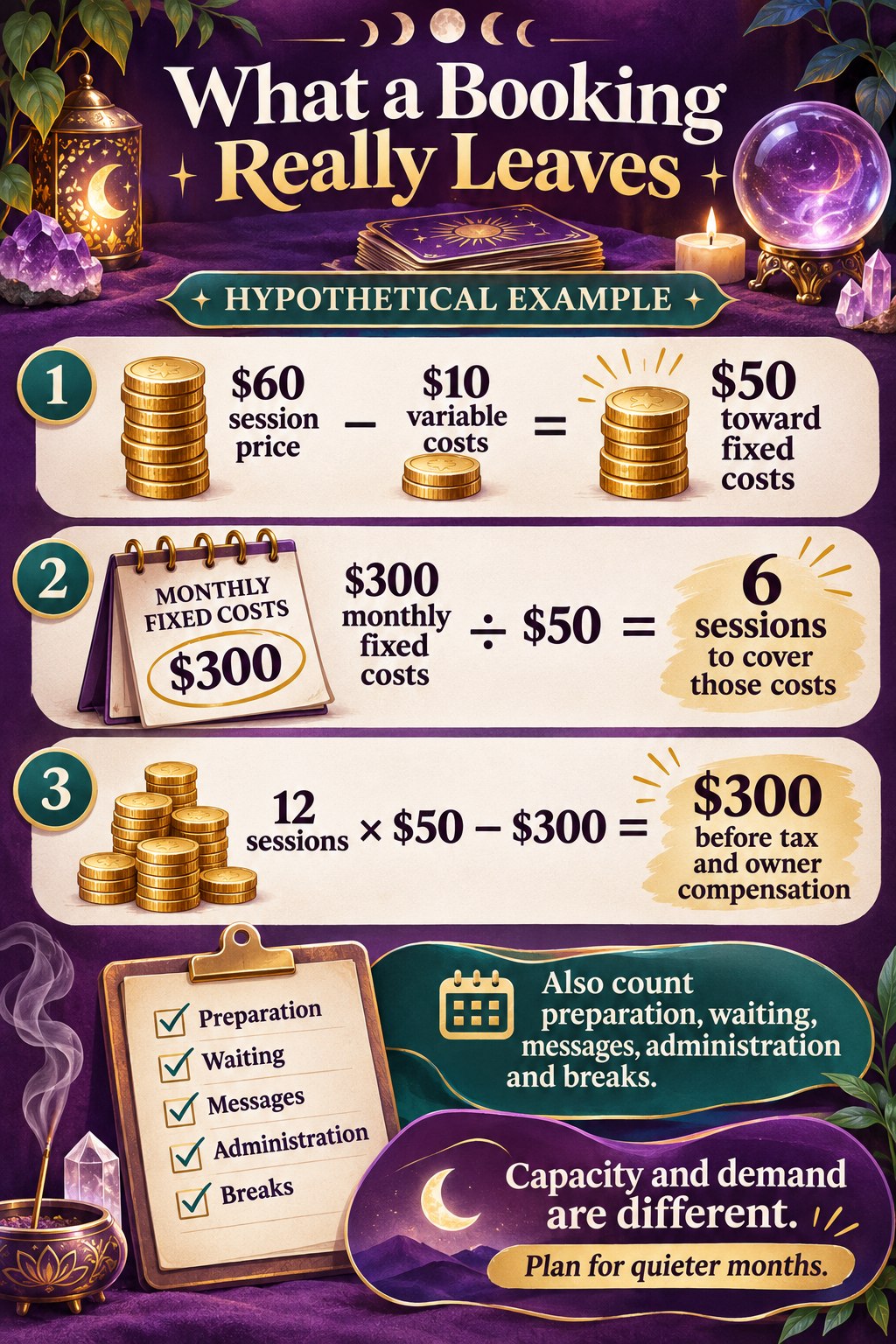
The U.S. Small Business Administration’s planning resources cover startup costs and break-even analysis. A basic service calculation is: fixed costs divided by the amount left from each sale after its variable costs. This covers fixed business costs, not automatically your living expenses, tax or unpaid labor.
Free reading-service income worksheet
- Offer: What is included, how long does it take and what is the price?
- Cost per session: What varies with each booking, including actual payment or platform charges?
- Monthly fixed costs: What do you owe even if no one books?
- Available capacity: How many sessions fit after preparation, administration, breaks and other work?
- Demand: What do real bookings show? Compare a quiet month with your expected month.
- Personal plan: What remains before tax, owner pay, leave and benefits? What other income or reserve supports a slow period?
Hypothetical example: A $60 session with $10 in variable costs leaves $50 toward monthly fixed costs. With $300 fixed costs, six sessions cover those fixed costs. Twelve sessions leave $300 after those listed business costs, before tax and owner compensation. The example is a calculation, not a typical earnings claim.
Keep generosity within a planned limit
If you want to offer a reduced-price slot, free event or donation-based session, decide what you can afford and explain it plainly. You can help without promising unlimited availability. Clients should not be pressed to tip, donate or buy again to show belief.
Keeping another job while testing demand can be a deliberate business choice. So can reducing costs or closing an offer that does not work. Income is influenced by demand, pricing, time and circumstances; it is not a score for spiritual worth or proof that the universe supports or rejects you.
Review records regularly and use qualified advice for tax, insurance, registration and local obligations. Do not borrow or leave reliable income solely because a reading or manifestation exercise predicts success.
Review service quality without overclaiming
Look for preventable confusion: unclear prices, overly broad claims, sessions that run beyond agreed limits or advice that pressures a client. Invite feedback about the actual experience and accept disagreement.
A client’s satisfaction is worth hearing, but it does not certify a supernatural source. Do not respond to a complaint by declaring that the person lacks belief or has a blockage.
Keep ethical boundaries in place, including when someone needs support beyond the service’s scope. If your offer involves coaching, read coaching qualifications and limits before choosing a title.
Frequently asked questions
1. Can psychic work provide a full-time income?
It may for some people, but there is no guarantee. Review your own bookings, costs, available time and personal needs before relying on it.
2. Is charging for spiritual work wrong?
You can charge transparently for a defined service while respecting clients’ freedom to decline. Your values can guide pricing without guilt or pressure.
3. What should my offer describe?
State the actual format, topic, duration, price and limits. Avoid promises about health, guaranteed predictions or private information about others.
4. Does a high hourly price mean high earnings?
No. Advertised rates do not reveal booking volume, fees, expenses or unpaid work. Revenue and take-home income are different.
5. Which costs should I include?
Include actual fixed and per-session expenses, such as software, payment charges, equipment, marketing and appropriate insurance. Review obligations relevant to your location.
6. What is contribution per session?
It is the session price minus costs that vary with that session. The remaining amount contributes toward fixed costs and other needs.
7. How do I estimate break-even bookings?
Divide fixed costs by contribution per session when that contribution is positive. This basic calculation does not automatically cover tax, owner pay or living costs.
8. Should I count unpaid work?
Yes. Preparation, messages, marketing, bookkeeping and follow-up all use time even when they are not separately billed.
9. Can raising prices guarantee profit?
No. Prices interact with demand, costs and capacity. Review real results rather than assuming a higher rate solves the business.
10. Do I need another job?
That depends on your circumstances. Other income may support a gradual test of demand; it does not indicate a lack of ability or commitment.
11. Can I offer free or reduced-price sessions?
Yes, if you choose a sustainable limit and explain the arrangement. Avoid creating expectations of unlimited access.
12. Should clients tip to show they value my gift?
Do not use spiritual pressure to seek tips or repeat bookings. State any optional arrangement clearly and respect a decision to decline.
13. Does a financial struggle mean I have a money blockage?
Financial results do not diagnose a spiritual problem. Examine practical conditions and seek appropriate support rather than blaming yourself.
14. Can personal experience qualify me as a therapist?
No. Describe your training accurately and do not turn personal history or a workshop into a professional credential.
15. When should I review the plan?
Review actual income, costs, time and demand regularly and after meaningful changes. Get qualified help with local tax, legal and insurance questions.
It’s interesting to see how the concept of specialization can be applied to the field of psychic healing. Identifying a niche could indeed help practitioners differentiate themselves in a crowded market.
The article’s suggestion to keep a diary for self-examination and developing a personal brand is quite practical. This method allows for a structured approach to identifying one’s strengths and specializations.
Valuing one’s worth is an important reminder for anyone in a service-oriented profession. It’s essential for practitioners to recognize their unique contributions to fully serve their clients and grow their practice.
The idea of using personal experience to build trust with clients is compelling. It makes sense that clients would feel more comfortable with a healer who has faced similar challenges.
Absolutely. Personal experience can be a powerful tool in establishing authenticity and relatability, which are crucial for client trust.
The article provides a thoughtful approach to personal branding for psychics and healers. Understanding one’s unique strengths and experiences certainly seems like a foundational step in creating a successful practice.