


The best answers in a psychic reader interview explain your approach, show judgment, and describe how you treat your clients. They don’t have to promise a perfect prediction. A reader can talk confidently about their own practices while acknowledging uncertainty and protecting the client’s freedom.
If you’re going to do an interview, think beyond the spiritual labels. An employer might want to know how you listen, communicate, manage a paid reading, and respond if someone is distressed. These are skills you can talk about with examples. The same questions are useful if you’re hiring readers for your own platform.
An interview can look at communication and compliance with the platform standards. It cannot, by itself, give scientific validation of paranormal gifts. Keeping the difference clear makes it more credible. Applicants can talk about real experiences without turning selection criteria into unsupported claims of proven psychic accuracy.
The sample answers below are just examples, and they don’t claim training, client experience, or qualifications that someone has. A real beginner’s answer is a strong answer that is easy to support when the interviewer asks follow-up questions.
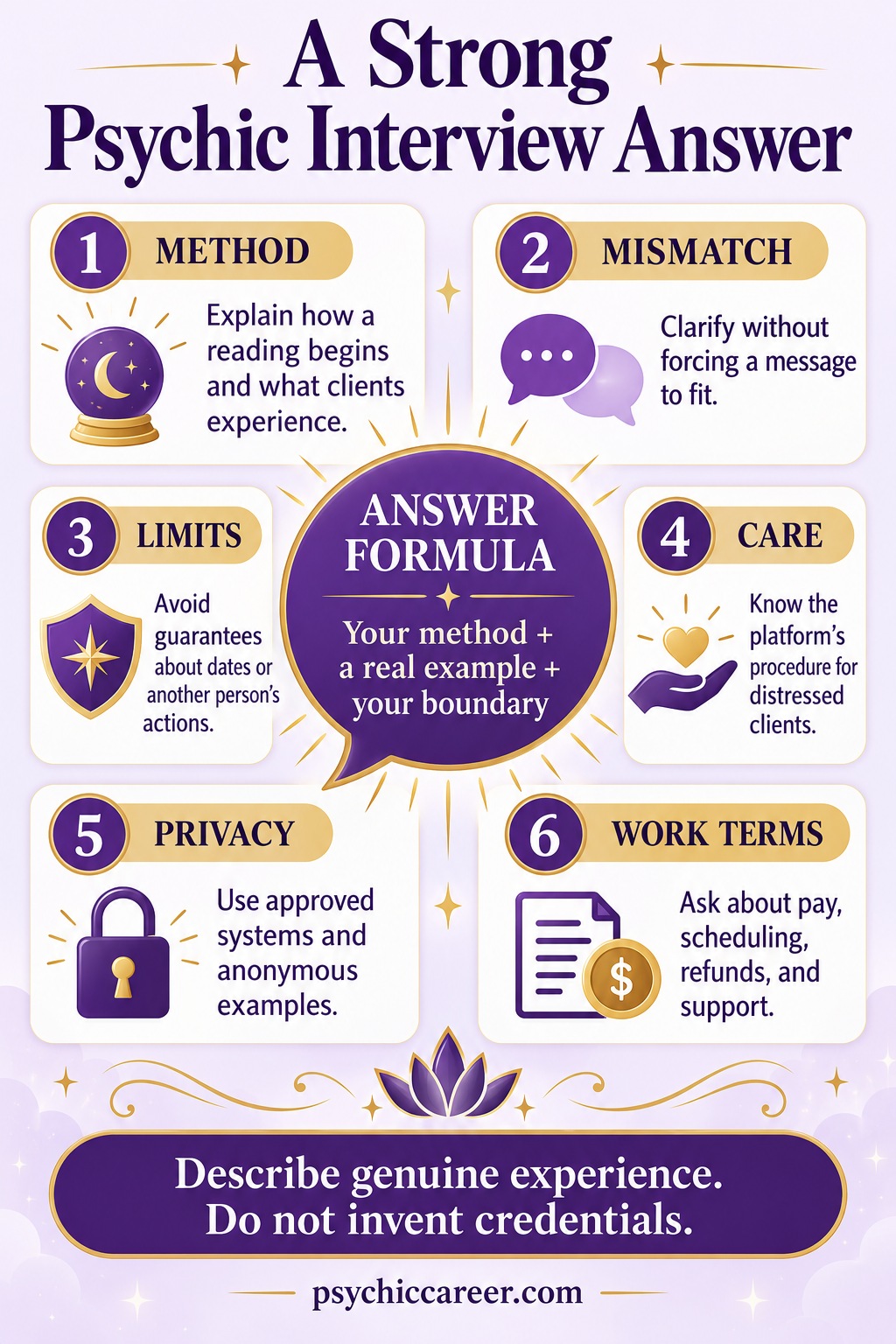
Read the infographic as text
- ANSWER FORMULA: Your method + a real example + your boundary
- 1. METHOD: Explain how a reading begins and what clients experience.
- 2. MISMATCH: Clarify without forcing a message to fit.
- 3. LIMITS: Avoid guarantees about dates or another person's actions.
- 4. CARE: Know the platform's procedure for distressed clients.
- 5. PRIVACY: Use approved systems and anonymous examples.
- 6. WORK TERMS: Ask about pay, scheduling, refunds, and support.
Describe genuine experience. Do not invent credentials.
Kinds of Questions for a Reading Interview
Interview formats are different. A platform might use an application, identity checks, a written questionnaire, or a live conversation. An independent business might focus more on referrals and a discussion of its service policies. Look at the actual requirements before you prepare for a certain role.
Keen's advisor application guidance, for example, talks about many screening steps, including identity verification, a questionnaire, content review, and a skill assessment. These are its published requirements. They should not be presented as the universal process for all psychic employers.
Be prepared to talk about your reading method, specialties, boundaries, customer service, and availability. You might also be asked to talk about an interpretation in plain language. A good response helps the interviewer know what a client would actually experience instead of thinking that you can rely on a phrase such as “I connect deeply” without describing the reading.
Keep your examples anonymous. If your story is about a former client, don’t give a name or detailed history to be convincing. Pick a different example. The interview is an opportunity to show confidentiality as well.
How Would You Explain the Way You Give Readings?
A good answer should give the interviewer an idea of how you work and what a client can expect during a reading. For example: “Tarot is the main tool used during readings, along with psychic impressions and messages that come through. Each reading begins with the client’s question, and the cards are explained in easy language. Clients are also welcome to ask for clarification if something needs more explanation.”
This tells the interviewer what method you use, how you begin a reading, and how you communicate with clients. If your specialty is mediumship, astrology, past lives, dream interpretation, or something else, talk about the methods and psychic gifts you actually use. Don’t just add specialties because they sound impressive or might attract more clients. Being clear about what you offer can help connect you with clients who are actually looking for your type of reading.
You can also talk about the spiritual side of your readings and what that means to you. Some readers work closely with spirit guides, energy, tarot, astrology, psychic impressions, or other spiritual practices. Explain how those things become part of your readings and how you share what comes through with clients.
An interviewer might also ask what makes your reading style different. This is a good place to talk about the way you connect with clients. Maybe your style is warm and conversational, you’re especially good at explaining complicated card combinations, or you like giving clients a clear summary before the reading ends. These details can help the interviewer understand what it might actually feel like for a client to have a reading with you.
What Do You Do When Something Doesn’t Connect with the Client?
A good answer might be: “If something doesn’t connect with the client, that’s okay. The meaning can be explained a little more, and the client can ask questions about what came through. If it still doesn’t connect, the reading can move forward instead of trying to force that particular message to fit.”
This shows that you can stay comfortable and professional when a client doesn’t immediately connect with something. Not every message, card, symbol, or psychic impression is going to make sense to a client right away. Sometimes the meaning becomes clearer later, while other times it just might not connect with that particular situation.
Try not to make the client feel like they’ve done something wrong because a message doesn’t fit. Telling someone that they’re spiritually blocked, refusing to accept the truth, or hiding information can make the reading uncomfortable. It’s usually better to explain what came through, give the client room to respond, and then continue with the reading.
If the interviewer asks for an example, you can talk about something you learned from giving readings. Maybe experience taught you to explain the difference between the general meaning of a tarot card and the specific message or impression connected with it during a reading. Examples like this can show how your reading style has developed over time.
An interviewer might follow up by asking, “What would you say to the client?” An easy response could be: “That’s okay if this part isn’t connecting with you right now. We don’t have to force it to fit. We can leave it here and continue with the question you wanted to explore.”
A calm response like this lets the client know that it’s okay to say when something doesn’t connect. It also allows the reader to trust what came through without feeling like every part of the reading has to be defended or explained until the client agrees.
Client Guarantees
If I ask for a guarantee, you can answer directly: “I would explain that I can’t guarantee another person’s actions or a future event. I would offer to look at the client’s choices in the agreed reading scope. If they need a guarantee before they make the purchase, I wouldn’t misrepresent the service to secure a booking.”
Always keep the same boundaries for exact dates, pregnancy claims, medical diagnoses, court decisions, and financial situations. Readers shouldn’t use certainty to get a client to go past concern to make a payment or take a risk. A confident delivery style doesn’t mean you promise more, but you show more support.
UK’s ASA guidance on spiritual and psychic services addresses misleading or irresponsible advertising and vulnerable consumers. It is relevant to UK advertising, and its broader emphasis on responsible claims offers a useful discussion point. Local rules and the employer’s policies still need to be checked.
For a hiring manager, a warning sign is an applicant who treats guarantees as regular sales language. Ask how the wording would look in a profile and in a live conversation. The advertised service and the service delivered need to tell the same story.
Distressed Clients
If you get a distressed client, a strong answer separates compassionate listening from professional care. You could say something like, “I would slow down the conversation, check if the client wants to continue, and not make frightening predictions. If the issue is outside my role, I would explain my limits to them and give them a resource under the platform’s procedure.”
If the client is in immediate danger or is at risk of self-harm, I would follow the employer’s crisis protocol and encourage them to get urgent local support. A psychic reader should never try to manage a crisis by predicting that everything’s going to be fine. Interviewers need to provide a clear process instead of leaving the reader to invent one when under pressure.
You can still show compassion in a short example. A client who is overwhelmed after a breakup might hear, “We can pause. You don’t have to make a decision right now during this reading.” This respects the person without claiming a diagnosis or giving them their partner’s hidden intentions.
Don’t give a clinical technique as a treatment unless you have relevant qualifications and you’re working in a separate professional role. The interview should make clear which role you’re applying to perform. Using spiritual language in a counseling title without explaining credentials can confuse the client about what service you’re offering.
For a hiring manager, a warning sign is an applicant who treats guarantees as regular sales language. Ask how the wording would look on the profile and in a live conversation. The advertised service and the service itself need to tell the same story.
How Would You Handle a Client Who Keeps Coming Back to the Same Question?
A good answer might be: “If a client keeps asking the same question, it can help to find out what they’re still trying to understand. The reading might have given them an answer, but they could still feel uncertain or have another part of the situation they want to explore. The question can sometimes be approached from a different direction instead of just repeating the exact same reading.”
If a client keeps asking, “Will they text me?” If that question has already been explored, the reader could ask if they want to look at something more helpful, such as what might be keeping communication from moving forward or what they can focus on while they wait. This can give the reading somewhere new to go without just repeating the same information.
There can also be times when a client is looking for repeated readings because they’re hoping the answer will change. If that starts happening, it’s okay to gently point out that the same question has already been covered. A reader can still be caring and supportive without encouraging someone to keep spending money on the same question over and over again.
An interviewer might also ask what happens when a client wants to continue after reaching the budget or time limit, they agreed to. A good response should respect that original limit. The reader can summarize the main messages that came through, answer a final question if there’s enough time, and bring the reading to a comfortable close.
The platform has a responsibility here too. If readers are rewarded for keeping calls going longer, they still need to feel comfortable ending a reading when it reaches a natural stopping point. Clients should never feel like something frightening or dramatic is being introduced at the last minute just to keep them on the call.
How Do You Keep Client Information Private?
A good answer should explain what you do to protect client information. For example: “Client information stays within the approved systems used for readings. Only the information needed for the reading is collected, and any notes are handled according to the platform’s privacy rules. Personal client stories aren’t shared publicly or used in a way that could identify someone.”
Readers should also understand the privacy policies of the platform they work through. A reading might feel like a private conversation between the reader and client, but certain information could also be handled by authorized support staff, payment services, or other systems used by the platform. Knowing how that information is handled makes it easier to explain privacy accurately to clients.
Find out what notes can be kept, how long they’re stored, and if readers are allowed to save information outside the platform. The same applies to recording, transcription, or AI tools. If a platform has rules about these tools, follow them and don’t just copy private client conversations into another program because it makes writing notes easier.
If an interviewer asks for an example of how you’ve protected a client’s privacy, keep the example focused on what you did instead of telling the client’s personal story. You might say, “When asking a supervisor for help with a communication issue, identifying details about the client were left out.”
That answer shows how you handled the situation without revealing the very information you’re explaining how to protect. Client trust can be an important part of psychic work, and respecting someone’s private information is one more way to protect that trust.
Experience and Training
Name courses, settings, and customer service experiences accurately. Completing a tarot card course means that you took the course, but it doesn’t automatically mean that you have regulated qualifications, clinical experience, or predictive accuracy. Explain what you learned and how it changed your work.
If you’re new, you might say, “I’ve practiced tarot card readings in a study group and have experience handling customer questions in a different role. I’m building my paid practice, so I want clear supervision and policies before I accept hard cases.”
This answer shows readiness to learn without pretending that you have years of clients. Interviews need to be able to look at practice readings, unpaid community work, and paid professional experiences. Each can be relevant when they’re described honestly.
You may be asked for testimonials. Use only genuine comments with permission and appropriate context. The FTC's endorsement guidance explains the importance of honest and real endorsements and relevant disclosures in US advertising. Positive feedback about kindness or clarity should not be recast as proof of guaranteed results.
Talk About Payments and Scheduling
Be ready to explain breaks, availability, and limits on readings. Don’t promise to be available at all hours of the day, just to be committed. A schedule you can keep is better than making promises that cause you to be too tired.
Ask about compensation, whether time between calls is paid, and which fees and commissions apply. Make sure you know the expectations for refunds, common disputes, and unpaid administrative work. These are things that a real job should help you understand before you accept it.
If you’re asked how you’d handle a complaint, talk about a calm process, such as listening, reviewing the service agreement, avoiding arguing, and following the resolution policy. You can acknowledge communication problems without admitting to claims that you didn’t make or promising something you can’t give.
For hiring managers, practical answers show whether an applicant can work reliably; they can also reveal where the employer needs clearer policies. An interview should not require someone to guess what the employer expects about recording, billing, or handling clients who are vulnerable.
Get Ready to Show How You Give a Reading
Before doing a reading demonstration, find out what the interviewer wants to see and how the demonstration will be used. A short sample reading can give them a good idea of your reading style, psychic gifts, communication skills, and the way you connect with clients. It shouldn’t turn into a long unpaid reading or require you to share private information that has nothing to do with the position.
Practice ahead of time with an everyday question, such as asking for guidance about a new opportunity or an upcoming change. Use the same methods you would normally use with a client. If you work with tarot, explain the cards and what stands out to you. If you receive psychic impressions, messages, symbols, or feelings, explain what comes through in the way you normally would during a reading.
There’s no reason to create a perfect moment or make something sound more impressive just for the demonstration. Let the interviewer see how you actually work. A genuine demonstration gives them a much better idea of what clients will experience when they have a reading with you.
Afterward, think about how the demonstration went. Did you answer the question that was asked? Did you explain the messages clearly? Did you stay within the amount of time you were given? Also think about if you felt comfortable using your normal reading style and if there’s anything you would explain differently next time.
The goal is to give the interviewer a clear picture of you as a psychic reader. Being able to listen, explain what comes through, communicate comfortably, and stay focused when a reading takes an unexpected direction can all be important parts of the job. Your psychic gifts are part of what you bring to the reading, but the way you connect and communicate with clients can be just as important in building their trust.
Final Thoughts: Supporting Standards
Before you accept a role, ask how the reader learns the policies and who they can contact when there are hard readings. A written crisis process, a complete procedure, and a clear explanation of billing expectations make it easier to keep the site running correctly.
Ask if the call ends because a question is outside what they’ll answer. How is the decision reviewed? This question allows you to ask if the business supports the boundaries it described to you in the interview. You might want to know if a policy changes and how updates are communicated.
For employers, strong interview answers need to include practical expectations after hiring. A reader can’t consistently follow the rules if they’ve never been given the procedure. Clear procedures, fair pay, thoughtful selection, and ongoing support need to work together.