


If you want to write a psychic profile that earns clients’ trust, explain what you offer, how the reading works, and where the limits are. Readers who value intuitive guidance need ordinary information before they spend money.
The client should be able to understand what your method is, the kind of questions you allow, the cost, and what they can expect afterwards. A profile is a description of the service offered. It can show your spiritual outlook without saying that every interpretation is guaranteed. Setting clear boundaries can make the experience feel comfortable because clients don’t have to guess what your words mean. For example, someone seeking relationship guidance should be able to see whether the reader’s approach fits their question.
A useful profile turns broad labels into specific expectations. The checklist below shows how to describe your methods, the focus of your readings, and your clarification policy.
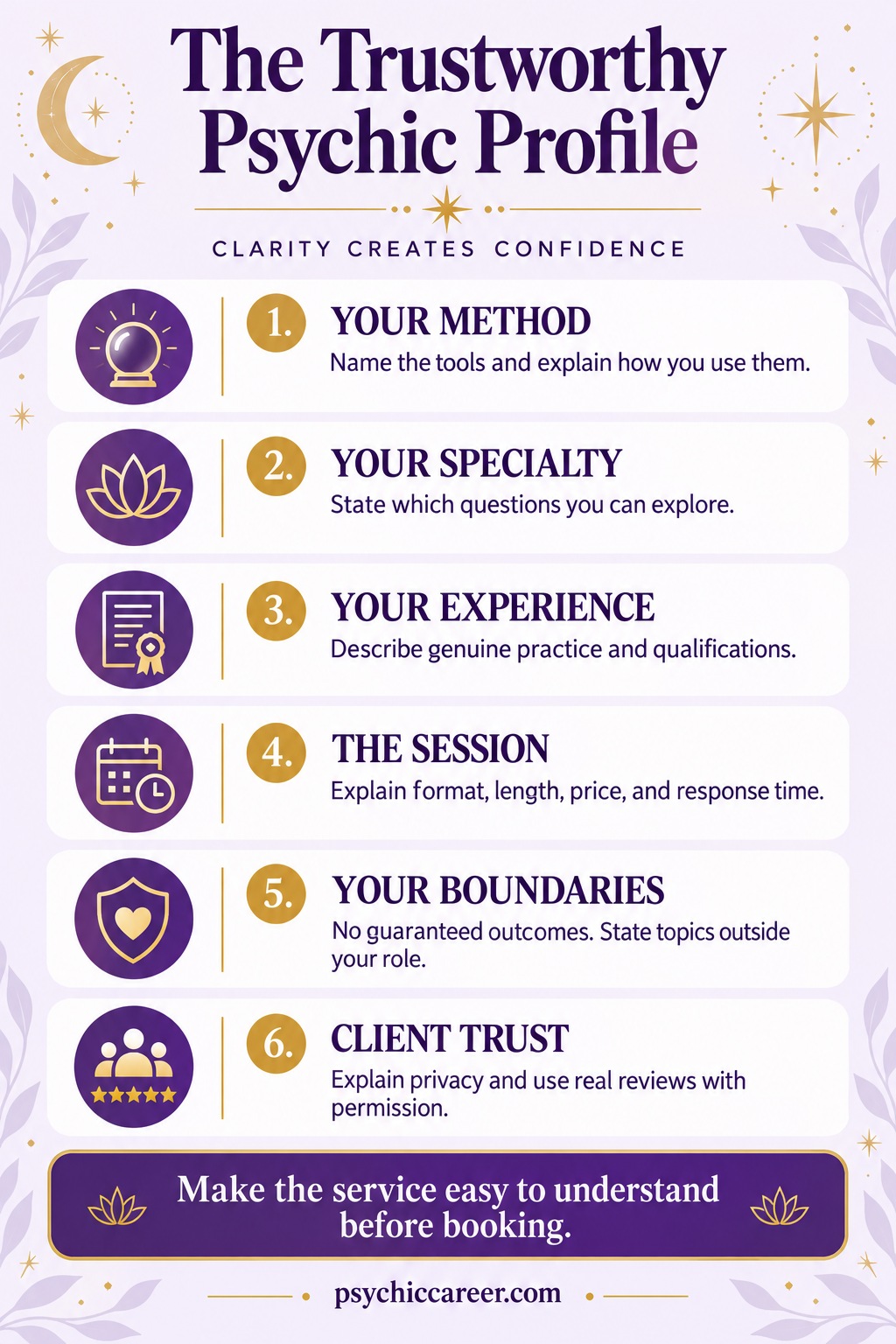
Read the infographic as text
- 1. YOUR METHOD: Name the tools and explain how you use them.
- 2. YOUR SPECIALTY: State which questions you can explore.
- 3. YOUR EXPERIENCE: Describe genuine practice and qualifications.
- 4. THE SESSION: Explain format, length, price, and response time.
- 5. YOUR BOUNDARIES: No guaranteed outcomes. State topics outside your role.
- 6. CLIENT TRUST: Explain privacy and use real reviews with permission.
Make the service easy to understand before booking.
Three Details Clients Should Understand Before Booking
A client should be able to picture the reading before contacting you. Use these three details to turn a list of gifts or specialties into a clear description of your service.
Describe Your Reading Tools and Method
Tell clients how you work. If you use tarot or oracle cards, explain whether you interpret a spread, discuss the symbolism, or combine cards with intuitive impressions. If you work without cards, say so. Naming your method helps clients decide whether your style matches the reading they want.
“I use tarot cards alongside intuitive impressions, and explain the symbols and themes as we go.”
Explain What Your Reading Focuses On
Describe the questions you welcome and how you approach them. For relationship readings, you might explore communication, patterns, boundaries, and the client’s next steps. If your approach includes impressions about another person, present them as interpretations rather than confirmed knowledge of private thoughts or a promise about their behavior.
“My relationship readings explore the connection and your options, while leaving room for uncertainty and each person’s choices.”
Make Questions and Clarification Easy
Say when clients can ask questions and what follow-up is included. A live session may allow clarification while time remains; an email reading may have a defined follow-up window. Explain your actual policy, including whether a new topic requires another booking, so clients can plan their time and budget.
“Please ask if a message needs explaining. Clarification is welcome during our session; new topics may need more time.”
Adapt these examples to your own voice, the services you actually provide, and your platform’s policies. Clear details help clients recognize whether your approach suits them.
Client Experiences
Your opening sentence can talk about the method and the main subject in one or two sentences. You might say something like, “I offer tarot card readings and intuitive readings for people reflecting on direction, relationships, and change. The reading starts with a focus question, is followed by an explanation of what the cards say, and leaves time for clarification.”
This shows more than just “I will reveal your destiny,” but tells clients what happens and allows them to compare the services. Get rid of strong wording and use your own approach. If the service is email only, say this in the beginning instead of letting clients think they can talk to you live.
Use spiritual language when it has a clear meaning in your practice. If you’re talking about yourself as a clairvoyant, explain how this helps you use your impressions during a reading. Writing a sentence about symbolism, images, or your intuitive process gives more information than labels put together.
You can include your own personality in your profile as well. You might say, “My communication style is direct and calm.” This allows the reader to think about the conversation. Make sure that the examples you use support your description. A profile that promises gentleness but uses scary language about curses gives mixed signals to the client.
Explain What Your Specialties Actually Include
Talking about specialties such as love, career, and spiritual growth can mean different things, so give clients a little more information about what you actually offer. A love reading might focus on communication, relationship patterns, boundaries, dating, or what someone wants from a relationship. Giving a little detail helps clients know what kind of reading they can expect before they book.
Dream interpretation can also cover different things. Explain if your readings focus on symbols, emotions, personal connections, spiritual meanings, or a particular tradition. A recurring dream, for example, might have several possible meanings depending on what happened in the dream and what the client connects with it. Let clients know what kind of dream interpretation you provide so they can decide if it matches what they’re looking for.
Only list specialties that actually fit the readings you offer. If astrology is part of your work, explain what type of astrology you use and what information the client needs to provide. The same idea applies to tarot, mediumship, past lives, energy readings, or other spiritual practices. A little more information can make a specialty much easier for clients to understand.
An easy way to describe a specialty is to finish the sentence, “This specialty helps clients explore…” For example, a relationship specialty might help clients explore communication, emotional patterns, or what they want moving forward. This keeps the description focused on what clients can expect from the reading instead of leaving them with a broad title that could mean almost anything.
Share the Story Behind Your Psychic Gifts
A little personal background can help clients get to know the person behind the profile. You might talk about when you first became aware of your psychic gifts, how you became interested in tarot or astrology, spiritual traditions you grew up around, or what led you to begin giving readings. Keep it focused enough that clients can still easily find the information they need about your services.
If psychic or spiritual practices have been part of your family for generations, that can be a meaningful part of your story. Explain what those traditions meant in your family and how they influenced your own spiritual path. Personal experiences like these can help clients understand where you’re coming from and why this work became important to you.
Be clear about your experience too. If you began studying tarot ten years ago but started giving professional readings three years ago, explain the difference. This gives clients a better picture of both your spiritual background and your experience working with clients.
If you’re newer to professional readings, you can still create a strong introduction. Talk about what you’ve studied, the practice you’ve completed, the psychic gifts or methods you work with, and the types of readings you feel most comfortable providing. You don’t need to make your experience sound bigger than it is.
A profile that feels genuine can go a long way in helping clients decide who they feel comfortable contacting. Sharing your real background, experience, reading style, and spiritual path gives clients a chance to connect with you before they even book their first reading.
Describing Qualifications
Always name the organization that gave you a certificate and describe the course. A private spiritual certificate is different from a professional license or a degree. Don’t use wording that makes one look like another.
If you have a qualification in counseling or healthcare, talk about whether you’re offering that kind of service in this kind of setting. A psychic platform listing shouldn’t make clients think they’re entering a clinical relationship just because the credential shows up in the biography.
FTC's small-business advertising guidance explains that advertising claims need an appropriate basis in the US. The practical lesson for profile writing is straightforward: describe achievements you can support and avoid numbers or claims that your records cannot establish.
If something says it’s 99% accurate, it needs more than just a testimonial. This should raise questions about what accuracy means, which samples have been missed (if any), and who assesses the results. If you can’t answer these questions, take off the percentage and just say what the service offers.
Showing Structure
Clients like to know when a reading starts, what information you ask for, and whether the questions can change during the reading. Describing the process can prevent mismatched expectations from becoming complaints.
You might say something like, “We agree on one question at the start, and I describe the reading as it moves forward. You can ask for clarification, and then at the end, I summarize the themes and any reflection questions you want to keep. Then include a summary of the service that’s provided.”
If you do an email reading, write down the number of questions, the expected response length, and the clarification policy. If you do a phone reading, explain how the time is managed. If the platform bills by the minute, tell the client where they can see the current rate instead of giving a total fixed amount that you can’t control.
Don’t turn the profile into a complicated contract. The important questions should be understandable and easy to read. There should be detailed policies without having to search through service terms. Clear writing allows the client to find out what matters without looking through long biographies.
Setting Boundaries
Boundaries can be practical and respectful. You can say something like, “I’ll focus on your choices and perspective, and I don’t guarantee other people’s actions.” This is clear without putting the client down for asking a question.
You can also say, “For urgent health or safety concerns, use the right professional support.” This shows boundaries without dismissing a spiritual interest.
If you don’t read about certain subjects, say so before a client books. The client shouldn’t pay for a pregnancy question for you to decline it. Offer a reflective question when appropriate, but don’t suggest that a reworded question can give certainty.
UK’s ASA guidance for spiritual and psychic advertising addresses responsible claims and the risk of exploiting vulnerable consumers. It is a UK advertising resource, not a global licensing standard. Its principles are a useful reminder to review how a worried client might understand your profile.
Setting a boundary can also protect consent. You can say something like, “You can pause or end a session, and if you want to do that, you don’t have to discuss why. You can also keep things private if you want to.” “This helps the client to have their own choice in participating.” This should be consistent with the billing platform and cancellation terms.
Explaining Privacy
Saying something like “everything is completely confidential forever” might be inaccurate if you use a platform that has support staff, recordings, or messages that are retained. Make sure you read the privacy and service policies before you describe confidentiality in your own words.
Explain your own role. You might say that you don’t share client stories and that communications are handled through the platform under their privacy policy. If you keep notes, describe this accurately and always follow the rules.
FTC's security guidance for businesses emphasizes practical protection of personal information. For a reader, this supports asking for only necessary information and using appropriate systems. Do not collect identification, medical documents, or payment details merely to make a profile feel more professional.
If you use AI to draft summaries or messages, this can affect the client’s decision about whether to share information. Always describe the material tools and follow the service’s policies. A human reading and an AI response shouldn’t be treated as the same without explaining it.
Let Client Reviews Speak for Themselves
Real testimonials can give potential clients a better idea of what it’s like to have a reading with you. A client might mention that they felt comfortable talking with you, that you explained the cards in a way they could understand, or that the reading gave them something meaningful to think about. Comments like these can help someone decide if your reading style feels like a good match.
Keep testimonials close to what the client originally said. If someone says, “The reading helped me think differently about my next conversation,” don’t change it to, “This reader saved my relationship.” Those two statements have completely different meanings. The original comment already gives potential clients useful information without making it sound like the client experienced something they never actually said.
If a testimonial came from a friend, a discounted reading, a promotion, or another special situation, make sure you follow the platform’s rules about how that information should be shared. The same applies to paid endorsements or other arrangements. Being clear about where feedback came from can help clients understand what they’re reading.
If you don’t have testimonials yet, that’s okay. Focus on explaining your reading style, psychic gifts, specialties, experience, and what clients can expect when they contact you. You can also give a short example of how you normally approach a reading. There’s no reason to create reviews just because your profile is new.
Put Everything Together in Your Profile
Here’s an example of how a tarot card reader might describe their services:
“I offer tarot readings for adults who want guidance with relationships and personal changes. My reading style is warm and conversational. We’ll begin with the question you want to explore, and the cards will guide the reading from there. I’ll explain the cards, symbols, and messages that come through in easy language so you can understand how they connect with your situation.”
The next paragraph might say something like this:
“My specialties include love, relationships, communication, personal boundaries, and major life choices. You’re welcome to ask questions during your reading or let me know if something needs more explanation. Every reading is different, and you can always tell me if there’s a subject you don’t feel comfortable discussing.”
The final paragraph can cover the practical details:
“Phone readings use the rate shown on my profile, and we can agree on a time limit before the reading begins if you’re working with a particular budget. Take a look at the platform’s payment, recording, cancellation, and privacy policies before booking so you know what to expect. Psychic readings aren’t a replacement for professional medical, legal, or financial services.”
This is just one way a reader can put a profile together. Your actual profile can include more personality, your real experience, psychic gifts, specialties, and the type of connection you like to create with clients. The goal is to give clients enough information to understand who you are, how you read, and what they can expect before they decide to book a reading.
Look at the Profile
Take time to read the first few sentences of the profile on a small screen. Can you look at the services in reading format right away? Long introductions often hide good details below the point where the client will stop reading.
Ask someone you trust to talk about what they think you’re promising. If they hear something you didn’t intend, change the wording. Words such as “reveal,” “confirm,” and “ensure” can mean more certainty than a reader expects when they write them.
Look for outdated rates, old availability, unsupported credentials, broken links, and policies that aren’t consistent. Take out repeated adjectives and keep the examples that explain how your work goes. A profile is credible when all the sentences help the client understand something concrete. A trustworthy profile makes room for a spiritual connection and practical judgment. It tells people what they get to choose, respects their privacy and their budget, and leaves them free to pick if your approach fits their needs.
Final Thoughts: Pictures and Services
Use a current picture and other permitted images that show who you are honestly. Always follow the platform’s rules and don’t imply certain credentials or affiliations with logos that you aren’t allowed to use. A clear and calm image supports recognition without a big spiritual setting.
If you’re including a sample reading, label it as an example and use a fictional or appropriately anonymous situation. Don’t take an example and turn it into a testimony. Always explain your method through a sample instead of acting like you have a prediction that’s been verified.
Make sure that the sample matches what you’re offering. A good written example can create the right expectations. If wrong expectations are created, it can cause clients not to use your services. Consistency helps people to pick what they want with confidence.