

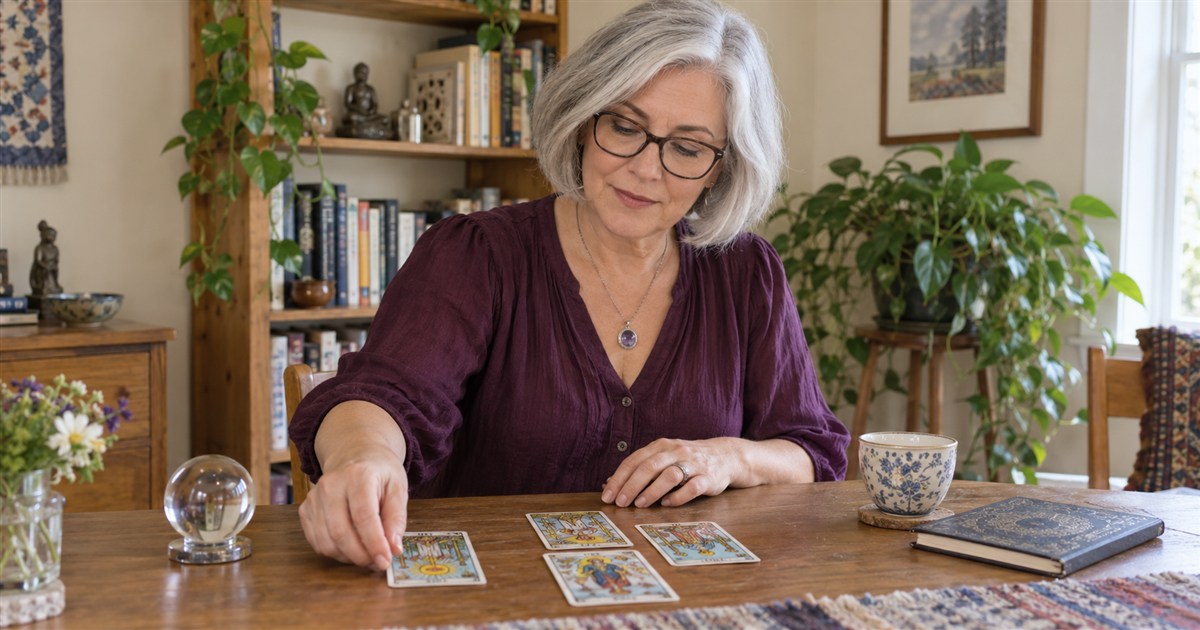
Divination tools offer different ways to work with symbols, questions and personal meaning. They are not interchangeable, and an appealing tool does not establish that its answers predict events or reveal hidden facts.
This guide compares ten approaches without ranking them by supposed power. If you are considering a reading practice, focus on learning the method, explaining its limits and keeping the client’s choices intact.
Compare the format before buying equipment
| Format | Examples | Practical consideration |
|---|---|---|
| Images and symbols | Tarot, runes, crystals | Learn the system and explain that interpretation is not verification. |
| Charts and written material | Astrology, reflective writing | Protect personal data and distinguish calculations from meaning. |
| Patterns and surfaces | Scrying, cup reading | Avoid straining to produce a result; participation stays optional. |
| Moving objects | Talking boards, dowsing rods, pendulums | Movement does not establish an outside source or a reliable answer. |
1. Tarot cards
A reader arranges cards and interprets their images, positions and relationships. A small spread can organize a reflective conversation; more cards do not necessarily produce more useful guidance.
Tarot’s history is not simply “ancient fortune-telling.” The V&A’s tarot history describes its earlier use as a card game and later fortune-telling associations. It dates the familiar Rider–Waite–Smith deck to 1909 and highlights Pamela Colman Smith’s artwork.
Check: whether the deck and guide are understandable to you, accessible in size and contrast, and within your budget. A card is not a job offer, diagnosis or evidence of another person’s thoughts.
2. Astrology
Astrology interprets celestial positions through a symbolic framework, often using a birth chart. Computing positions is different from showing that an interpretation accurately predicts a person’s life.
Check: what birth information is requested, how it is stored and whether the reader explains uncertainty. Do not infer a person’s employability, honesty or compatibility from a sign or chart.
3. Automatic or reflective writing
Automatic writing is sometimes described as writing received from a spiritual source. Ordinary free writing can instead be used to explore a question without making that source claim.
Try a brief, voluntary note about what you notice and what you still need to check. You can edit, disagree with or discard it. Do not treat a written impulse as an instruction you must obey.
Check: whether the practice remains comfortable and easy to stop. Writing that feels unfamiliar does not establish authorship by a spirit.
4. Runes
Rune readings interpret marked pieces, often by drawing or casting them. The symbols and interpretive rules depend on the set and tradition; a claim that every rune system has the same number of signs or universal meaning is too broad.
Check: which system the guide uses, how the symbols are explained and whether historical claims are sourced. Learn the context rather than attributing a measurable “vibration” to each mark.
5. Scrying
Scrying involves looking at a surface such as water, a mirror or a crystal ball and interpreting impressions. You need not force an image, stare into bright light or remain with a practice that feels unsettling.
Check: ordinary lighting and comfort. An impression is not proof of a future event. See gentle reflection without activation claims for an alternative that does not require visions.
6. Crystals
Crystals may be used as symbolic objects, chosen prompts or part of another method. A stone’s personal significance is different from a claim that it protects health, blocks harm or guarantees accurate readings.
Check: price, sourcing and practical suitability. Keep small pieces away from children and pets, and do not ingest them or use them in drinks. An ordinary object can serve as a reminder without an expensive collection.
7. Tea leaves and coffee grounds
Cup readings interpret shapes in residue. A pattern can become a conversation prompt, but its meaning is supplied through interpretation rather than verified by its appearance.
Check: what the session involves and whether you are comfortable participating. You do not need to drink unfamiliar herbal mixtures to have a reading. The herb safety and focus guide explains why spiritual claims should not substitute for product-safety checks.
8. Talking boards
A talking board uses a movable pointer with letters, numbers or other markings. Participants may interpret the result as a message. That interpretation does not establish contact with a deceased person or an outside intelligence.
The historical 1891 Elijah Bond patent describes a game apparatus; a patent is not proof of supernatural function.
Check: everyone consents and can stop. Avoid presenting a session as a guaranteed way to obtain closure, identify an attacker or resolve a serious decision.
9. Dowsing rods
Dowsing uses rods or branches whose movements are interpreted as locating something. The US Geological Survey’s overview states that scientific evidence does not support the effectiveness of dowsing.
Check: whether someone is substituting a demonstration for professional assessment. Do not rely on dowsing to locate missing people, assess drinking-water safety or make costly drilling decisions.
10. Pendulums
A pendulum is a weight suspended from a cord or chain. Some practices assign meanings such as yes or no to its movement. The object can move while you feel still; movement alone is not a verified answer.
Check: whether the question belongs in a symbolic exercise at all. Do not use a pendulum to decide medication, pregnancy, financial commitments or another person’s consent. “Trust every answer” is not a responsible instruction.
Choose one method for one modest purpose
- Name the purpose. Are you learning symbolism, journaling or exploring a spiritual tradition?
- Keep the cost modest. Borrow a guide or begin with materials you already have where appropriate.
- Set a stopping point. No purchase or unusual experience is required to prove commitment.
- Review the result. Separate interpretation from facts with the four-step reading review.
If you offer sessions to clients
Explain the method, price, duration and limitations before starting. Get permission for sensitive topics and any recording. Let the client disagree or stop without implying punishment, blocked energy or a lost opportunity.
Use the consent and boundaries guide to build service standards around conduct—not the claim that a more elaborate tool makes a reader more accurate.
Frequently asked questions
1. Which divination tool is most accurate?
This guide does not rank tools by predictive accuracy. A format or tradition does not itself establish that its answers are reliable.
2. Do I need many tools to begin?
No. Choose one modest purpose and learn the relevant method before buying a collection.
3. Were tarot cards always used for fortune-telling?
No. Tarot has an earlier card-game history, with fortune-telling associations developing later.
4. When was the Rider–Waite–Smith deck published?
The V&A dates the familiar deck to 1909 and highlights Pamela Colman Smith’s artwork.
5. Can tarot tell me whether I will get a job?
Do not treat a card as an offer or employment guarantee. Check actual vacancies, requirements and written terms.
6. What private data might an astrology reading request?
A reader may request birth date, time and place. Ask why the information is needed and how it will be handled.
7. Does automatic writing prove a spirit wrote the words?
No. Unfamiliar or spontaneous writing does not by itself establish an outside author.
8. Do all rune sets have the same symbols?
No. Check which system and interpretive guide the set uses rather than assuming universal symbols or meanings.
9. Must I see a vision while scrying?
No. Do not force an image or continue a practice that feels uncomfortable. You can choose plain reflection instead.
10. Do crystals guarantee protection?
No. Personal symbolism is not a guarantee of health, safety or reading accuracy.
11. Must I drink special herbs for a cup reading?
No. You do not need to consume an unfamiliar mixture to participate in symbolic reflection.
12. Does a talking board prove contact with the dead?
No. The result does not establish an outside source, and it should not be promised as a reliable route to closure.
13. Does a patent prove a divination tool works?
No. A patent documents an invention; it is not proof of supernatural function.
14. Can dowsing replace professional water assessment?
No. Scientific evidence does not support dowsing’s effectiveness. Use appropriate professional assessment for consequential water decisions.
15. Should I use dowsing to locate a missing person?
No. Contact the appropriate authorities and use ordinary search and reporting procedures.
16. Is pendulum movement a reliable yes-or-no answer?
Movement alone does not verify an answer. Do not rely on it for medical, financial or other high-stakes decisions.
17. Can I use a tool to find someone’s hidden feelings?
Do not treat an interpretation as established knowledge of another person’s private thoughts or consent.
18. What should a reader explain before a session?
Explain the method, full price, duration, limitations, privacy arrangements and the client’s ability to disagree or stop.
19. What if a practice becomes frightening?
Stop and seek independent support. Do not buy further sessions merely because a seller says payment will prevent harm.
20. How should I review the result?
Record the wording, sort the kind of claim, check independent facts and choose a modest action or no action.
Honestly, this whole divination thing seems like a bunch of nonsense. It’s hard to believe that reading cards or staring into a crystal ball can actually provide meaningful insights. Just stick to reality, folks.
While I find the concept of divination intriguing, I can’t help but feel it’s just a fancy way of avoiding real decision-making in life. Relying on cards or stars to guide your future seems quite irrational to me.
I understand your skepticism, but many people find comfort and clarity through these practices. It’s all about personal belief and what resonates with you! 😊
True, but isn’t it also a fun exploration? A little mystery can spice up life! Just don’t take it too seriously, right? 😜
‘Divination’? Sounds like magic mumbo jumbo to me! If I need answers, I’ll stick to Google instead of a crystal ball! 😂 Seriously though, why would anyone trust this stuff?
‘Tarot cards are so cool!’ My friend reads them for fun during our girls’ night in. Even if they aren’t accurate, it’s entertaining and leads to great conversations about our lives! 💖
Totally agree! It’s like having your own personal fortune teller without any commitment or pressure. It’s all in good fun! ✨
I found this article to be absolutely enlightening! The way it breaks down the various tools of divination really gives a clear understanding of how they work and their historical significance. Well done! 🌟
‘Automatic writing’? Sounds more like scribbles from someone who forgot to pay attention in class. I can’t believe people take this seriously—it’s just messy writing at best! 😒
Divination has a rich history that ties into cultural practices across various civilizations. Understanding the mechanics behind tarot or astrology can offer insights into psychology and human behavior as well. It’s fascinating how these tools have persisted over centuries.
I agree with you! The psychological aspect is often overlooked but plays a crucial role in how individuals perceive their lives through these tools.
Exactly! Plus, it’s interesting to see how different cultures interpret similar practices in unique ways. There’s so much depth to explore!
‘Ouija boards?’ Really? Aren’t we just asking for trouble by inviting spirits into our lives? Seems like a recipe for disaster if you ask me! Better stick to safe hobbies like knitting. 🧶
‘Ouija boards are just party games!’ said no one ever after using one. Seriously, if you’re not careful, you might just invite something creepy into your home—good luck with that! 😂
‘Just party games’? Yeah right! I’ve heard stories that would make your hair stand on end after using one of those boards.
‘Scrying’ sounds so poetic yet eerie at the same time! It’s amazing how human beings have sought ways to connect with something beyond themselves throughout history. These practices surely deserve more study.
This article beautifully encapsulates the rich history and diversity of divination practices. It’s fascinating to see how ancient techniques still resonate with many people today. 🌟 I appreciate the insights provided!
‘Automatic writing’? More like automatic scribbling if you ask me! Can you imagine just doodling nonsense and calling it divine insight? 😂 But hey, if it makes someone feel better, go for it!