


After a psychic reading, you may have a mixture of feelings, suggestions and predictions to untangle. A written review can help you keep what is useful without turning every statement into an instruction.
Use four steps: record, sort, check and choose. This is a reflection exercise, not a way to establish psychic accuracy. You can decline advice, leave a claim unanswered or decide not to book another session.
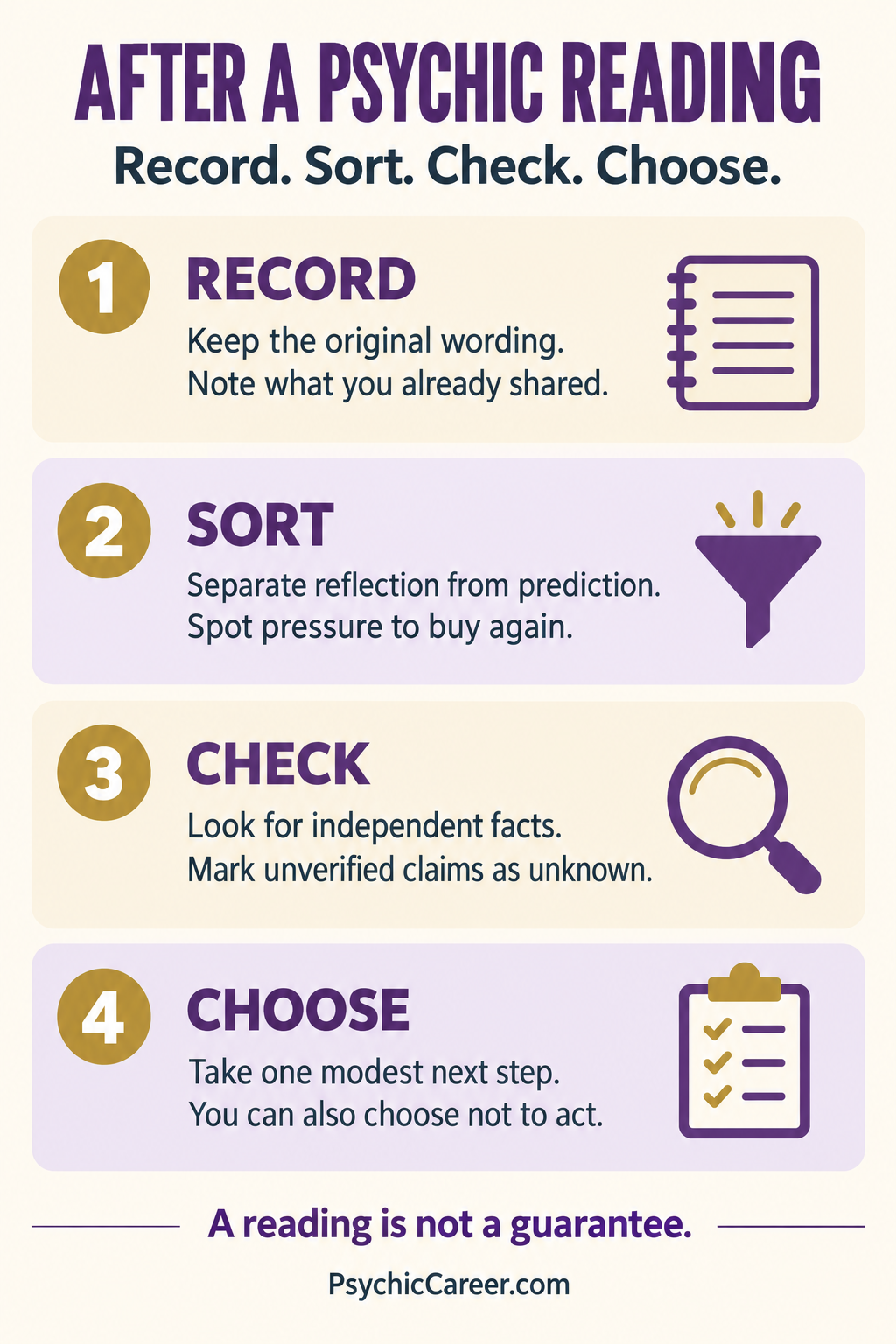
1. Record the wording, not an improved version
Keep a short note of the date, question, information you supplied and key statements. Distinguish the reader’s exact words from your own interpretation. “A change may be coming” is not the same as “I will get the job next month.” Do not make a vague statement more specific after something happens.
If recording audio, obtain permission beforehand and check the service’s rules. Written notes are enough for this exercise; do not publish private session material or another person’s information without permission.
A useful note format
- Original statement: what was actually said.
- My reaction: reassured, doubtful, worried or undecided.
- Context already shared: relevant information the reader knew.
- Unanswered question: what I still need to find out.
2. Sort statements into different kinds
A session can feel meaningful even when its predictions remain unverified. Sorting helps you avoid giving every kind of statement the same weight.
| Kind of statement | Example | How to handle it |
|---|---|---|
| Personal reflection | “You seem to value more independence.” | Consider whether it fits your experience; disagreement is allowed. |
| Practical suggestion | “Ask what training the role requires.” | Assess the cost, relevance and ordinary evidence. |
| Prediction | “An offer will arrive in six weeks.” | Do not treat it as an offer or stop your job search. |
| Claim about someone else | “Your manager secretly wants you gone.” | Do not accuse anyone on that basis. Look at actual conduct and communication. |
| Pressure to buy | “Pay again or you will lose this opportunity.” | Pause the purchase and seek an independent perspective. |
3. Check facts independently
For a career question, check the vacancy, required skills, working conditions and written terms. For an interpersonal issue, rely on actual communication rather than a claim to know hidden thoughts. For medical, legal or financial decisions, seek appropriately qualified help.
Several readers giving the same answer does not establish that answer’s accuracy. They may be responding to similar information, broad themes or your question’s wording. Buying more readings is not a substitute for checking the underlying facts.
Use the practical job comparison worksheet if you are choosing between roles. It keeps spiritual prompts separate from skills, costs and working conditions.
4. Choose a small, reversible next step
Ask what you would do if the prediction had never been made. A useful action usually remains sensible without it: update one résumé section, ask about a schedule, compare course costs or have a direct conversation.
Avoid irreversible decisions based on a reading alone. Do not resign, borrow money, ignore medical care or accuse another person because a prediction feels certain. Keep applying for work and meeting existing responsibilities while uncertain claims remain uncertain.
Try this sentence: “Because I can check ____, I will ____. I will review the result on ____.” The checkable reason should be something other than the reader’s assurance.
Review without moving the goalposts
If a statement included a specific time or event, keep that wording intact. Do not repeatedly extend the timeline or count every loosely related event as confirmation. Note clear misses and unanswered points as well as apparent matches.
A practical outcome is different from proving a supernatural source. A thoughtful question may help you organize your priorities; that does not establish how a reader arrived at the suggestion.
If the reading leaves you anxious
Pause before purchasing clarification. Talk with a trusted person who is not selling another session. If fear disrupts everyday life, seek qualified support. Threats of curses or harm unless you pay deserve particular caution; read practical safety and fear-based sales warnings.
If you do choose a follow-up, agree its price and scope first. You do not owe a reader further purchases, positive feedback or acceptance of their interpretation. The consent and boundaries guide explains how clear limits support both reader and client.
A one-page review you can reuse
- Record: the wording, question and information already supplied.
- Sort: reflection, suggestion, prediction, third-party claim or sales pressure.
- Check: the independent evidence and what remains unknown.
- Choose: one modest action, no action or qualified advice.
The review is complete when you have regained room to choose—not when every prediction has been made to fit.
Frequently asked questions
1. Must I follow everything said in a reading?
No. You can disagree, decline advice or choose not to act. A reading does not remove your responsibility or right to decide.
2. What should I write down first?
Record the original wording, your question, the date and relevant information you already supplied. Keep interpretation separate.
3. Can I record the session?
Ask permission beforehand and check the service’s rules. Written notes are sufficient for this review.
4. How do I separate reflection from prediction?
Reflection explores your experience or priorities. A prediction asserts something about a future event. Neither should automatically become an instruction.
5. Does an accurate-sounding statement prove psychic ability?
No. A statement feeling personal or matching something does not by itself establish a supernatural source.
6. Should I ask several readers for the same answer?
Repeated purchases can increase cost and confusion. Agreement among readers is not a substitute for independent evidence.
7. What does independent checking mean?
Use information outside the reading: written job terms, direct communication, relevant records or qualified professional advice.
8. What if I cannot verify a statement?
Mark it unknown. You do not need to invent an explanation or make a decision based on it.
9. Should I wait for a predicted job offer?
Continue your ordinary job search. A prediction is not an offer, contract or guarantee.
10. Can a reading tell me what a manager secretly thinks?
Do not treat that claim as established knowledge. Use actual conduct and appropriate direct communication.
11. What is a reversible next step?
It is a modest action you can adjust, such as requesting information or revising a résumé, rather than resigning or making a major purchase.
12. What if a prediction misses its deadline?
Keep the original wording and record the miss. Do not continually extend the timeline to make the claim fit.
13. Does a failed prediction mean I caused it?
A failed prediction is not evidence of deficient belief, low vibration or a personal failure.
14. What if the reading makes me afraid?
Pause purchases and seek independent support. If distress disrupts daily life, contact a qualified professional.
15. Do I owe the reader a follow-up purchase?
No. If you choose a follow-up, agree its scope and full cost first. You can decide that no further session is needed.
The concept of having a support system and owning one’s actions resonates deeply. It underscores the importance of community and personal accountability in overcoming anxiety and making meaningful life changes.
The idea of ‘shelving’ concerns and focusing on one prediction at a time is practical advice. It can prevent overwhelm and help maintain a clearer perspective on the guidance received.
I agree. It allows for better integration of the advice received and can lead to more effective and actionable steps towards one’s goals.
Absolutely, focusing on one prediction at a time can streamline mental and emotional processing. It makes the whole experience less daunting and more manageable.
I appreciate the emphasis on self-love and emotional regulation. These are foundational aspects of mental health, and integrating them into a spiritual practice can enhance one’s ability to navigate life’s challenges.
The advice offered here on surrendering and acceptance is quite valuable. It emphasizes the importance of letting go of rigid expectations and embracing the present moment, which can be beneficial for overall mental well-being.
The use of the SOAP acronym could indeed provide a structured approach to managing the information received from a psychic reading. By breaking down each component, it may help individuals integrate these insights into their lives more effectively.