


A course advertised as “psychic development” may teach symbolic interpretation, spiritual practices, communication or a particular reading format. Before paying, find out exactly what you will learn and how the instructor handles uncertainty.
Participation does not establish supernatural ability, and a course certificate does not by itself prove predictive accuracy or qualify you for regulated professional work.
Describe the learning goal in ordinary terms
“Become more psychic” is difficult to evaluate. A clearer goal might be learning a tarot deck’s imagery, explaining service limits, writing a focused question or practicing a respectful conversation. Ask whether the course actually teaches that skill.
Use the divination tools guide to distinguish formats before buying equipment or enrolling. You do not need a collection of tools to start exploring one topic.
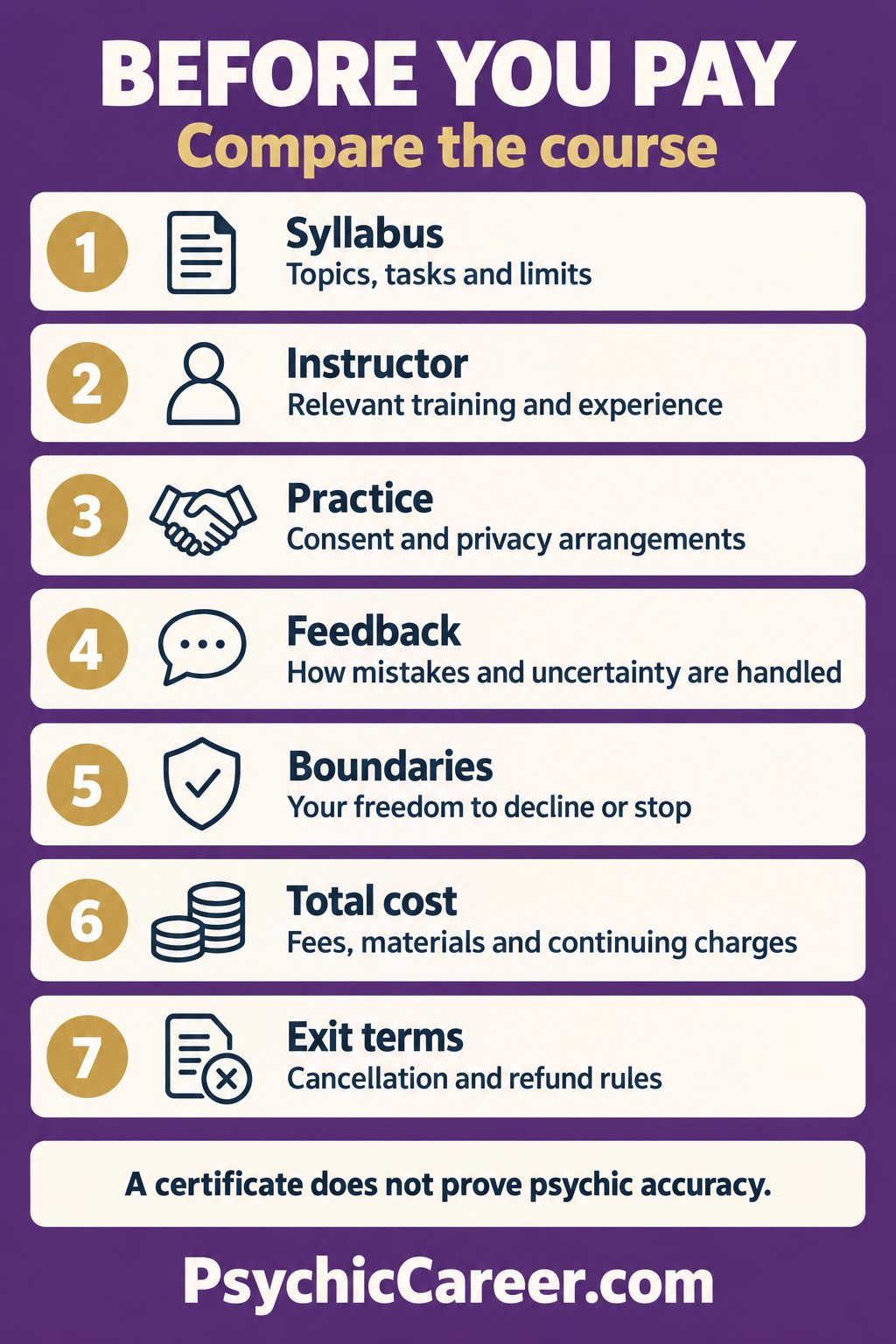
Seven questions for the course provider
| Check | Ask for |
|---|---|
| 1. Syllabus | Topics, learning tasks and what is outside scope. |
| 2. Instructor background | Relevant training and experience, described without unverifiable titles. |
| 3. Practice arrangements | Who participates, how consent works and how private information is protected. |
| 4. Feedback | How mistakes, uncertainty and disagreement are addressed. |
| 5. Boundaries | The approach to grief, health concerns, touch and stopping an exercise. |
| 6. Total cost | Fees, required materials, extra sessions and any continuing charges. |
| 7. Exit terms | Cancellation, refund rules and what happens if the format does not suit you. |
Get important answers in writing. A warm sales conversation does not replace the details you need to make a decision.
Look for learning, not a required belief performance
A useful class should let you ask questions and distinguish an interpretation from information you know independently. If every incorrect statement is explained away as the client’s resistance, there is little room for honest feedback.
Do not accept pressure to perform a reading on someone who has not consented. Nor should a class require revealing personal trauma, claiming messages from a deceased relative or touching another participant as proof of progress.
For practical standards, read the consent and scope guide.
No forced breakthrough
You do not need to empty your mind, distrust ordinary reasoning or repeatedly purchase activation to demonstrate commitment. Avoid exercises that push you to continue through distress or treat concerning experiences as automatic confirmation of a gift.
Do not use substances, sleep loss or forced intensive practices to try to produce an experience. A course instructor’s spiritual title is not a clinical qualification. The experience and claim guide explains why unusual experiences should not be turned into an ability verdict.
Separate course completion from paid work
Ask whether an advertised opportunity is a real written arrangement or merely a suggestion that graduates may apply somewhere. Course completion does not guarantee acceptance, clients, income or favorable ratings.
If you want to offer readings, you will also need to understand scheduling, administration, pricing, privacy and service boundaries. Do not base a budget on a promised earnings figure or assume that buying the next level creates employment.
Try the smallest useful learning step
Read a sample lesson or course outline if available. Consider whether the format fits your time, access needs and budget. You can learn a single topic, pause or decide not to enroll. A decision to stop is not evidence that your energy is blocked.
A comparison note to keep
Write down the skill you want, the evidence that the course teaches it, the total commitment and the conditions for leaving. If those remain unclear, you do not have enough information to decide.
Frequently asked questions
1. What might a psychic-development course teach?
Ask the provider. It may cover symbolism, a reading format, communication or spiritual practices; the title alone is not a syllabus.
2. Does completing a course prove psychic ability?
No. Participation or a certificate does not establish supernatural ability.
3. Does a certificate qualify me for regulated work?
Not by itself. Check the actual qualifications and authorization required for that role.
4. What is a clearer learning goal than becoming more psychic?
Choose a concrete skill, such as interpreting a deck’s imagery or explaining session limits.
5. What should I ask about the instructor?
Request relevant training and experience rather than relying on impressive titles.
6. Why ask about consent in practice sessions?
Participants should understand the exercise and remain free to decline or stop.
7. Must I disclose private trauma to participate?
Do not accept pressure to reveal personal information as proof of progress.
8. What should useful feedback include?
Room to examine mistakes, uncertainty and disagreement without blaming the participant or client.
9. Is client resistance a complete explanation for a wrong statement?
No. It should not replace honest review of what was claimed.
10. Do I need many tools before enrolling?
No. Check the actual requirements and start with the smallest useful learning step.
11. What costs should I check?
Fees, required materials, extra sessions and continuing charges.
12. What exit terms matter?
Cancellation, refund rules and arrangements if the format does not suit you.
13. Should I continue through a forced breakthrough?
Do not push through distress or treat it as proof that more paid intervention is needed.
14. Does a course guarantee paid reading work?
No. Completion does not guarantee acceptance, clients, income or ratings.
15. Can I choose not to enroll?
Yes. Unclear scope, cost or terms are reasons to seek more information or leave the offer aside.
The article’s suggestion about communicating with spiritual guides is thought-provoking. It implies that establishing a dialogue with these entities can be a way to gain insight and guidance. An intriguing perspective, even for skeptics.
The differentiation between the various types of clair abilities is helpful for anyone new to exploring psychic gifts. It’s a clear guide to understanding which senses might be more developed in different individuals.
Pearl, I found that part useful as well. It seems like focusing on one clair at a time could help in honing these gifts more effectively.
Indeed, Pearl. It’s quite enlightening to see the breakdown of each type as it provides a structured approach to self-discovery in this realm.
Self-love and affirmations are well-known self-improvement techniques, but their connection to enhancing psychic abilities is an interesting take. It is a reminder that nurturing oneself holistically can have broad-reaching benefits.
The article provides a comprehensive overview of various psychic gifts and how to cultivate them. The emphasis on self-care and mindfulness is especially practical and aligns with well-established psychological practices.
I agree, Ronda. The integration of things like affirmations and energy work with psychic development is an interesting approach that could benefit many.
The concept of ‘Mind Junk’ and its impact on psychic abilities is intriguing. It makes sense that a cluttered mind could impede one’s intuitive capabilities. Meditation and deep breathing as suggested could be beneficial regardless of one’s beliefs in psychic phenomena.