


You do not need a single lifelong calling to make a useful career decision. A better-fit job is one that meets enough of your needs, uses or develops relevant skills and is realistic to pursue. No assessment, reading or enthusiasm can guarantee the outcome.
This six-step plan helps you gather information before committing to training or a major change. It works whether you are employed, returning to work or considering your first role. Paying the bills is a legitimate priority—not a failure to follow a dream.
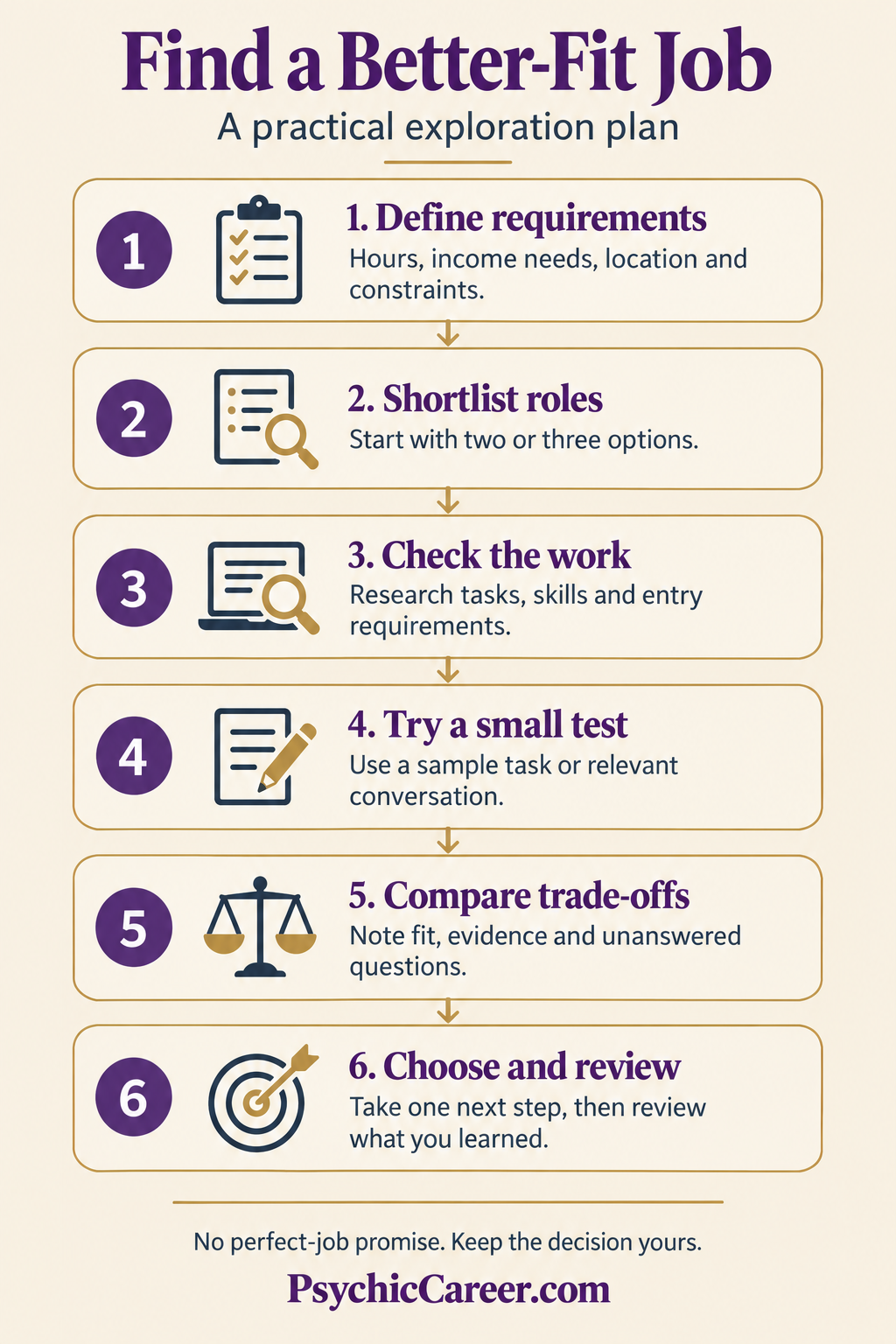
1. Define your requirements
Write what the work needs to accommodate: income needs, hours, location, travel, accessibility, care responsibilities and available training time. Separate requirements from preferences. If a role conflicts with a non-negotiable need, an inspiring title does not solve the problem.
Choose three priorities for the next stage rather than trying to optimize your whole life at once. You can revise them as circumstances change.
2. Build a small shortlist
Start with two or three roles you want to investigate. Include something familiar and, if useful, an option you have not considered closely. Interest assessments may generate ideas, but their results are not instructions or a measure of your worth.
Our life-path and career reflection guide distinguishes symbolic prompts from actual role research. You can skip symbolism entirely and still use the practical questions.
3. Research the work, not just the title
O*NET OnLine provides U.S. occupational information, including tasks, skills and other work characteristics. Use it as a starting point; requirements and opportunities depend on the employer and location. Compare descriptions with current relevant postings and ask for clarification where needed.
Write down what is still unknown
For each role, record typical tasks, entry requirements, schedule questions and possible costs. Add a separate line for information you have not yet confirmed.
4. Try a limited, relevant experiment
A conversation with someone doing the work, a permitted observation or a small sample project can reveal more about routine tasks. Set a time and spending limit. You do not need to enroll in a long course merely to explore an interest.
For example, before pursuing event coordination, try planning a small fictional event: list dependencies, make a schedule and revise it after a change. Ask for feedback on the plan. The exercise does not prove job readiness; it can identify questions and skills to investigate.
5. Compare trade-offs
| Option | Meets my requirements? | Evidence I have | Next unknown to check |
|---|---|---|---|
| Role A | List fit and conflicts. | Tasks researched; sample tried. | Clarify entry requirements. |
| Role B | List fit and conflicts. | Relevant conversation; posting reviewed. | Confirm schedule expectations. |
This is a worksheet, not a ranking formula. Use our job-comparison guide for additional practical dimensions. A role can be interesting and still be unsuitable at this stage.
6. Choose a next step and review point
Decide on one action: clarify a requirement, complete a work sample, update an application or investigate a training option. Note when you will review what you learned. A next step is not a promise to stay on one path forever.
When a plan does not produce the expected result, review the information and constraints rather than assuming you lack motivation. You can reduce the scope, ask a different question or explore another option.
Questions for an informational conversation
- What do you spend most of an ordinary week doing?
- What part of the work do newcomers often misunderstand?
- Which skills would you want to see demonstrated?
- What should I check before paying for training?
- Is there a suitable small task that would help me understand the role?
Respect the person’s time and do not request confidential workplace details. One person’s experience is useful context, not a promise that every employer works the same way.
Keep the search manageable
Choose a rhythm you can maintain alongside other responsibilities. Small, focused actions may be more workable than a constant search. Our job-search fatigue guide and career coaching strategies provide ways to structure the next stage.
If you also want a psychic reading, treat it as optional reflection. Our career shortlist after a reading explains why it should not replace role research, deadlines or your own decision.
Frequently asked questions
1. Can I find one perfect job for life?
No method guarantees that. Focus on a realistic better fit for your current needs and circumstances.
2. Is paying the bills a valid career priority?
Yes. Income needs and practical constraints belong in the decision.
3. How many roles should I start with?
Two or three can make exploration manageable. Revise the shortlist as you learn.
4. What is the difference between a requirement and a preference?
A requirement is a need the role must meet at this stage. A preference matters but may allow trade-offs.
5. Should an assessment decide my career?
No. It may suggest ideas, but results are not instructions or a measure of your worth.
6. What can O*NET OnLine help me research?
It provides U.S. occupational information such as tasks, skills and work characteristics. Check employer and location details separately.
7. Why research tasks rather than job titles?
An attractive title does not tell you what the routine work involves.
8. Do I need to buy training before exploring a role?
Not necessarily. Start by checking requirements and considering a limited conversation, observation or sample task.
9. What is a career experiment?
It is a small, relevant action designed to give you information about a role or skill without a large commitment.
10. Does a successful sample task guarantee a job?
No. It can provide feedback and identify skills to investigate, but hiring depends on other factors too.
11. What should I ask someone doing the work?
Ask about ordinary tasks, common misunderstandings, useful skill evidence and what to check before training.
12. Should I ask for confidential employer details?
No. Respect the person’s time and confidentiality.
13. How can I compare two roles?
Use the same requirements, evidence and unknowns for each, noting both fit and conflicts.
14. What if my first plan does not work?
Review the information and constraints. You may reduce the scope, change the question or explore another option.
15. Can a psychic reading replace career research?
No. Keep any reading as optional reflection, separate from evidence about roles, requirements and deadlines.
The emphasis on continuously pursuing one’s dreams is commendable. Career shifts are common, and the strategies suggested, like attending career fairs and taking classes, offer practical steps for anyone looking to find their niche.
The article highlights the significance of leveraging online platforms like LinkedIn for job hunting and networking. This digital age necessitates the use of such tools for career advancement and finding job satisfaction.
Seeking advice from friends and family can offer unique insights into one’s strengths and potential career paths. However, it’s crucial not to rely solely on others’ opinions and to seek professional guidance and resources as well.
The article provides a comprehensive guide for those uncertain about their career paths. The suggestions, such as taking career assessments and seeking mentorship, are particularly valuable. It’s important to explore various options before settling into a job.
Taking an active approach to career dissatisfaction by moving on from unfulfilling jobs is essential. Mental well-being should be a priority, and the article does well to address the importance of finding a job that aligns with one’s passions and skills.