

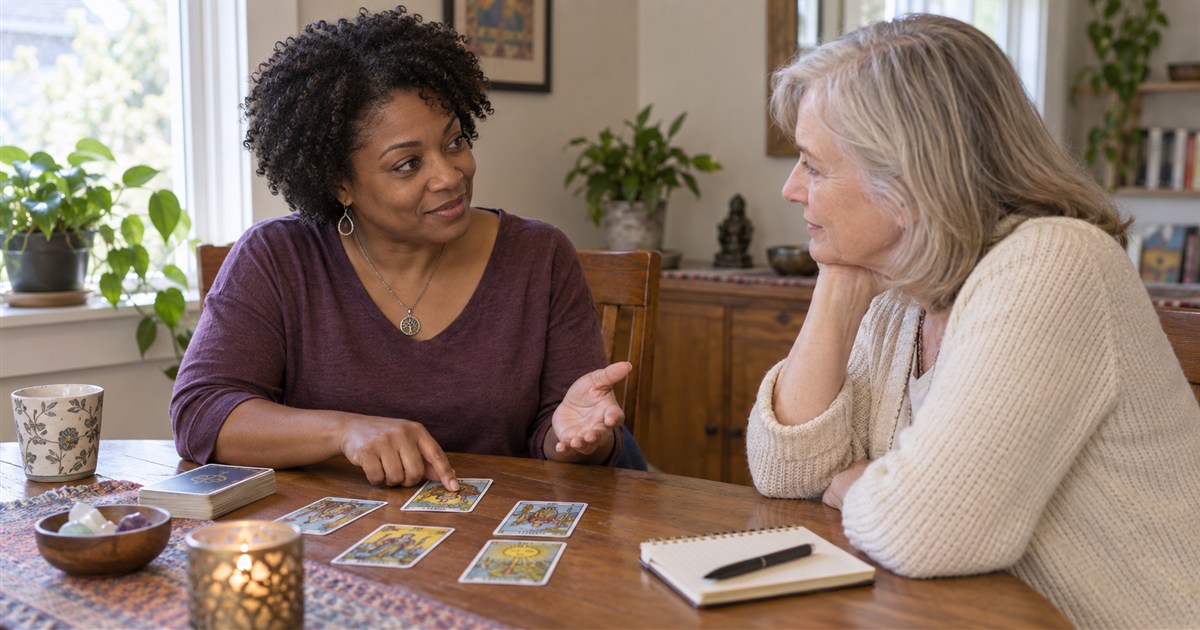
Before offering a practice reading, decide what you are offering and what the other person has agreed to. Confidence is not a substitute for permission, clear terms or an honest description of your limits.
These four steps are a service-preparation checklist, not a promise that anyone can develop paranormal powers. You can study a format without immediately charging, advertising expertise or taking responsibility for another person’s life decisions.
1. Describe the format and its limits
Write a short description: “A fifteen-minute tarot discussion using the cards as prompts for reflection on one everyday question.” State whether the reading is spoken or written, what tools you use and what is outside the scope.
Avoid claiming medical diagnosis, guaranteed predictions, access to someone’s secret thoughts or contact with a deceased person as a certainty. Your experience with a difficult situation does not by itself qualify you to counsel another person through it. Read ethical boundaries for readers before choosing a specialty.
2. Get a real agreement before starting
Ask whether the person wants a practice session. Explain its length, price if any and how to end it. An unsolicited reading about a friend’s relationship or grief is not made welcome by calling it a gift.
A simple invitation
“I am learning this format. Would you like a short practice discussion? It is optional, you can skip any question, and we can stop at any time. I cannot verify predictions or make decisions for you.”
Free and paid sessions both need clear terms. A free session should not become an unexpected sales pitch; a paid one should not hide an untested claim behind a confident tone. Keep the option to decline genuinely easy.
3. Keep the first practice small and low-stakes
Choose a topic such as a creative project or an everyday preference, not a diagnosis, investment, legal dispute or threat to safety. Use a short session with an agreed end. Let the person define the question rather than searching for a dramatic problem.
Say “This card could suggest considering another option” rather than “You must leave your job.” Check whether a reflection is useful without insisting that disagreement means blocked energy. See preparing for a tarot reading for question and privacy boundaries.
4. Review your conduct, not just compliments
Afterward, ask whether the scope was clear, whether the person felt able to disagree and whether the ending was respected. Feedback about comfort or usefulness can improve the service. It does not establish a supernatural source or predictive accuracy.
| Review question | What to improve |
|---|---|
| Did I stay with the agreed topic? | Remove intrusive detours. |
| Could the person correct me? | Make disagreement welcome. |
| Did I separate interpretation from fact? | Use clear, conditional wording. |
| Did I stop on time? | Set a clearer ending. |
Decide whether to continue
You do not need to turn every interest into a business. If you continue, compare training carefully and keep claims proportionate to what you can actually provide. Use the course comparison checklist and service-planning guide before buying credentials or publishing a profile.
Frequently asked questions
1. Do these steps prove I can become psychic?
No. They prepare you to offer a clearly bounded practice activity; they do not verify paranormal abilities.
2. Must I charge for a practice reading?
No. Decide whether it is free or paid and make that clear before someone agrees.
3. Does a free session still need consent?
Yes. Someone must be able to decline or stop even when no money changes hands.
4. What should I say about my experience?
Describe it honestly. Do not invent qualifications, clients or successful predictions.
5. What is a suitable practice topic?
Choose an everyday, low-stakes reflection rather than a medical, legal, financial or safety decision.
6. Can I offer an unsolicited reading?
Ask whether the person wants one first. Interest in helping does not replace their permission.
7. What if the person disagrees?
Accept the correction. Do not recast disagreement as blocked energy or a hidden confirmation.
8. Should I promise contact with someone who died?
No. Do not present such contact as certain or pressure a grieving person to participate.
9. Does positive feedback prove accuracy?
No. Someone can find a conversation comforting or useful without it establishing psychic accuracy.
10. Should I record sessions?
Not by default. Discuss any recording and its use in advance, obtain permission and avoid unnecessary private details.
11. Can personal trauma become a professional specialty?
Personal experience alone is not a professional qualification to diagnose or treat others.
12. What makes a session ending clear?
Agree the duration beforehand and honor a request to finish without an unexpected extension or sales pitch.
13. Do I need a certificate?
Evaluate what a course actually teaches and what its certificate means. A certificate does not verify psychic powers.
14. Can I stop learning this practice?
Yes. You can pause or choose a different interest without treating it as a failure.
15. What should I review after practice?
Review scope, permission, privacy, clarity, room for disagreement and the ending—not just praise.
The advice to avoid giving free readings to be taken seriously is quite insightful. It underscores the value of one’s time and skills, which is a valuable lesson in any professional field.
The writer’s recommendations, particularly about trusting the process and setting aside one’s ego, resonate well. These principles are relevant in various professional contexts, not just in the psychic domain.
The emphasis on overcoming fear and developing a thick skin is notable. It seems practical advice not just for aspiring psychics, but for anyone venturing into a new or unorthodox field.
The discussion about handling criticism and skepticism is crucial. Being prepared for diverse reactions can help one stay focused and persistent in their journey, which is an important takeaway from the article.
The article provides a balanced approach to developing psychic abilities, emphasizing the importance of practice and maintaining a positive mindset. It offers practical steps that could be useful for anyone serious about this pursuit.