

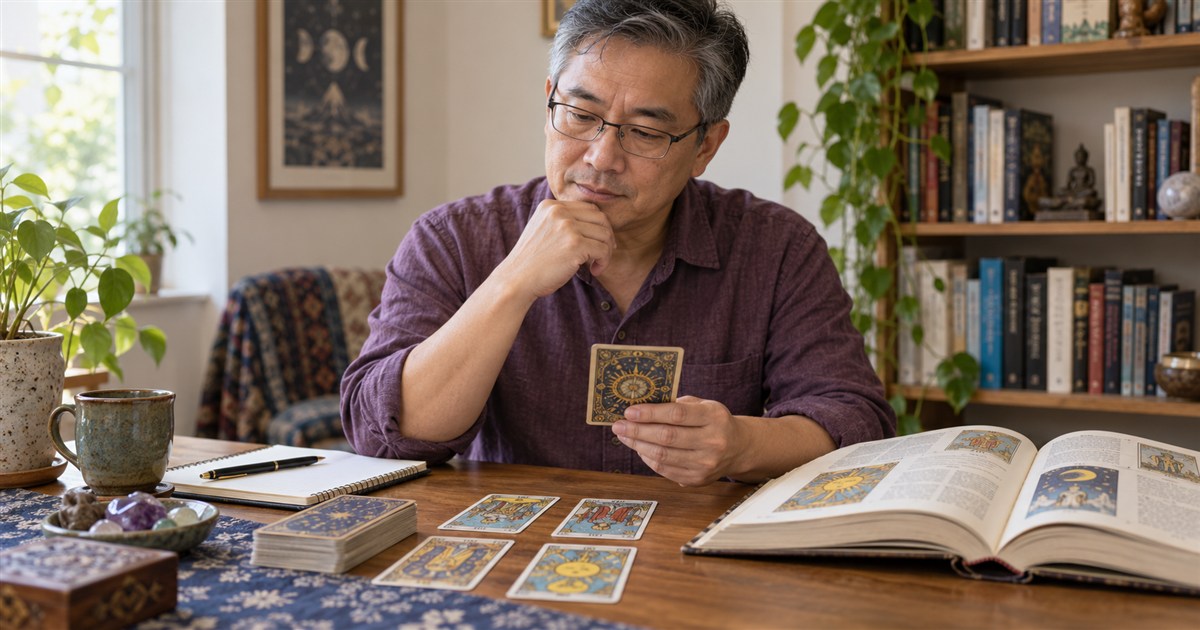
A psychic-development plan can organize your interests, but it cannot promise that you will gain supernatural powers. Define what you are actually learning and how you will review it.
You might want to understand tarot symbolism, communicate more clearly or explore a spiritual tradition. Those are different goals from demonstrating access to hidden information. Keep the distinction visible from the beginning.
Choose one learning goal
Replace “become more gifted” with a concrete question: “Can I explain how I interpret a card without calling it a fact?” or “Can I state a session’s limits before starting?”
A belief in awakening does not establish your soul’s rank or require you to give readings. For terminology, start with the reader-label comparison rather than treating a list of “clairs” as a verified ability inventory.
Use a four-part learning cycle
| Stage | Example |
|---|---|
| Learn | Read about one symbolic approach and its context. |
| Describe | Explain an interpretation and distinguish it from a fact. |
| Practice | Use a fictional, low-stakes scenario or a consenting participant. |
| Review | Note clear communication, limits and what needs checking. |
You can repeat the cycle at a pace that fits your responsibilities. It is not an eight-step universal path, an initiation requirement or a validated ability test.
Keep practice consensual
Agree on the purpose, topic, time, privacy and ending before involving another person. Do not practice by guessing their trauma, health condition or hidden relationships. A refusal is not a challenge to overcome.
Use the practice-reading agreement for a fuller setup. A participant’s gratitude or enjoyment may tell you about their experience; it does not by itself demonstrate psychic accuracy.
Review claims as well as technique
If you record an impression, keep the original statement and include misses. Do not change a prediction after the outcome or call every unclear result a success.
Ask what ordinary information was already available. You can appreciate a symbolic discussion while leaving its claimed source unverified. See the sudden-impression record for a clear separation between experience and conclusion.
Choose teachers by actual terms
A confident mentor is not automatically a trustworthy one. Ask about content, feedback, full costs, privacy and freedom to disagree. Clarify what a certificate does and does not represent.
Do not assume a group is safe simply because members describe shared energy. Observe how refusals and mistakes are handled. Use the course-selection checklist before committing money.
Do not make meditation compulsory
Some people include quiet reflection in a spiritual practice, but it is not proof of increased frequency, hidden information or powers. You do not need to skip ordinary relationships or responsibilities to maintain a daily routine.
You can choose another activity, shorten a practice or stop. The meditation guide discusses optional approaches and limits; this learning plan does not require it.
Decide what comes next
After a short period, ask what you learned, what remains unclear and whether the activity is still worth your time. You can continue a hobby, change direction or stop without treating the decision as a blocked gift.
Offering a paid service brings additional responsibilities. Clear limits and honest claims matter more than completing a development checklist.
Frequently asked questions
1. Can a plan guarantee psychic powers?
No. A learning plan organizes activities; it does not certify supernatural abilities.
2. What is a useful learning goal?
Choose a concrete skill or question, such as explaining a symbolic interpretation or stating session limits.
3. Does an awakening establish my soul’s rank?
Do not treat that belief as a verified ranking or an obligation to give readings.
4. What are the four learning stages?
Learn, describe, practice and review, with clear limits and honest checking.
5. Is the cycle a validated ability test?
No. It is a practical way to organize learning.
6. Must practice involve another person?
No. A fictional, low-stakes scenario can be used instead.
7. What should a participant agree to?
Agree on purpose, topic, duration, privacy and how the activity ends.
8. Can I practice by guessing someone’s trauma?
Do not use private trauma, health or hidden relationships as practice targets.
9. Does gratitude prove accuracy?
No. Positive feedback about an experience is not by itself evidence of psychic accuracy.
10. Should I keep misses in an impression record?
Yes. Preserve the original statements and include misses and unclear results.
11. Does confidence make a mentor trustworthy?
No. Review the actual content, fees, privacy and handling of disagreement.
12. Does shared energy make a group safe?
Do not assume so. Look at consent, refusals and actual conduct.
13. Must I meditate every day?
No. This plan does not require meditation or sacrificing ordinary responsibilities.
14. Can I stop exploring the topic?
Yes. Stopping does not demonstrate a blocked gift or personal failure.
15. Does completing a checklist qualify me to sell readings?
No. A paid service requires its own clear terms, honest claims and boundaries.
The article’s focus on practical exercises like meditation and regular readings is logical. These practices seem to be effective methods for strengthening psychic capabilities.
The mention of intuition being like a muscle that needs to be exercised is a compelling analogy. Trusting one’s feelings and practicing daily could indeed lead to improved psychic abilities.
The distinction between the different clairs is quite informative. It helps in identifying how different types of psychic information are received. This could be beneficial for individuals in understanding their unique abilities.
The suggestion to join groups and find mentors indicates the importance of community and guidance in developing psychic skills. It appears that collaboration can significantly enhance personal growth in this field.
The article presents an interesting take on developing psychic abilities. The emphasis on understanding one’s gifts and establishing a sturdy foundation is crucial. Meditation and readings appear to be fundamental practices that could benefit many.
I agree. The structured approach to increasing psychic abilities through meditation and readings seems practical and valuable.