

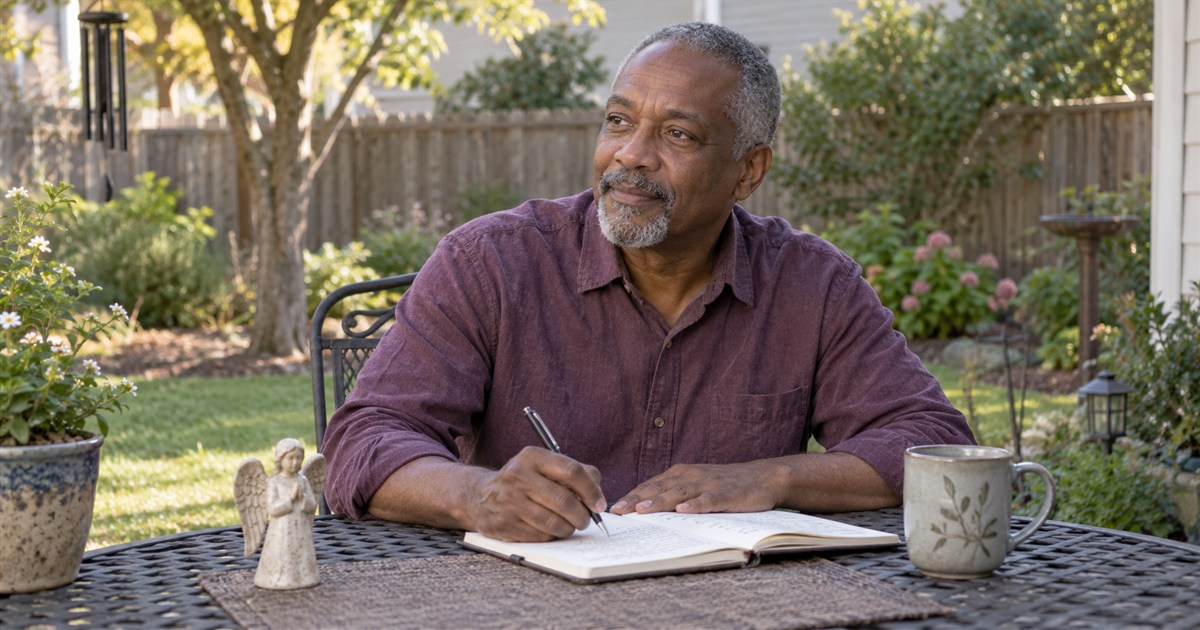
Some people include angels or guardian figures in prayer and reflection. If that imagery matters to you, you can use it to consider a question without claiming that it will reveal the future, validate every feeling or keep you safe from harm.
A personal interpretation should leave you more freedom to think—not make you afraid to question a supposed message.
Choose a question about your own action
Instead of asking for certainty about another person’s thoughts, consider what you can do responsibly. “How can I approach this conversation respectfully?” leaves room for preparation, consent and disagreement.
A prayer or reflection might help you express a value such as patience or honesty. It does not establish that a particular answer came from an angel or that a decision will work out.
A possible reflection, not a required formula
“I would like to act with care. What do I know, what am I assuming and what should I ask before proceeding?” You can use your own words or leave the spiritual imagery aside.
Keep a simple distinction in your notes
| Record | Example |
|---|---|
| What happened | I had a dream about a difficult conversation. |
| My interpretation | I wondered whether it reflected a concern I have. |
| What I know independently | The conversation is scheduled; I do not know what the other person will say. |
| My next step | Prepare one question and listen to the answer. |
Do not turn a striking detail into a verified instruction. A coincidence, dream or strong feeling can be meaningful to you without establishing its source or predictive accuracy.
For a separate reflection exercise, see asking a clear question without chasing a sign.
No compulsory sign search
You do not need to keep scanning numbers, dreams or ordinary events until they appear to confirm the answer you want. If nothing happens, that is not evidence of spiritual failure or a requirement to buy an activation.
Likewise, conflicting impressions are a reason to slow down rather than invent an explanation that makes every outcome correct. Keep unanswered questions unanswered until you have relevant information.
Do not use an impression as a safety guarantee
A reassuring interpretation cannot guarantee that a person, place or opportunity is safe. Check the circumstances directly and do not ignore a practical concern because a reader promises protection.
For work decisions, compare duties, schedule, cost and written terms. For health, financial or legal questions, use appropriately qualified support rather than spiritual certainty.
The intuition decision-check guide focuses on the situation rather than the strength of a feeling.
Keep quiet practices optional
You can reflect briefly while sitting comfortably, writing or taking an ordinary pause. You do not have to empty your mind, close your eyes or intensify a practice until a message arrives.
Stop if an exercise is uncomfortable. Distressing or concerning experiences should not be labelled automatic proof of angel contact. The guide to voices and clairaudience claims keeps interpretations separate from qualified support.
Respect other people’s beliefs and privacy
Do not tell someone that an angel has authorised you to enter their private life, disclose a secret or pressure them into a relationship. They can decline the interpretation without having to explain their own beliefs.
If you offer readings, describe the service as an interpretation and retain clear limits. An angel narrative does not override consent, confidentiality or the right to stop. Read the reader boundaries guide.
Use spiritual reflection in a way that leaves room for ordinary evidence, other people’s choices and your own ability to reconsider.
Frequently asked questions
1. Can angel imagery be part of reflection?
Yes, if it is meaningful to you and remains optional.
2. Does a reflection prove contact with an angel?
It does not establish the source of an impression.
3. Can an interpretation guarantee protection?
No. Check practical safety concerns directly.
4. What question should I start with?
Choose a question about your own responsible action rather than another person’s hidden thoughts.
5. Must I use the suggested wording?
No. It is an example, not a required prayer or formula.
6. What should I distinguish in a journal?
What happened, your interpretation, independently known information and your next step.
7. Does a vivid dream verify a future event?
Do not treat vividness or personal meaning as predictive accuracy.
8. Should I keep searching for signs until I get an answer?
You do not need to turn ordinary events into compulsory confirmation.
9. Does silence mean I need an activation?
No. A lack of a sign is not a requirement to purchase an intervention.
10. What if impressions conflict?
Slow down and leave unanswered questions open rather than making every outcome correct.
11. Should a comforting reading override written terms?
No. Check the actual arrangement and its limits.
12. Must I meditate until a message arrives?
No. Do not force or intensify a practice to produce an experience.
13. Can concerning experiences be labelled angel contact?
Do not use that interpretation to assess symptoms or delay qualified support.
14. Can someone decline my spiritual interpretation?
Yes. They do not owe you an explanation of their beliefs.
15. Does an angel message override consent?
No. Privacy, consent and the right to stop remain essential.
The concept of intuition as a form of inner voice or spiritual guidance is a recurring theme across various cultures. This article reinforces the importance of being mindful and contemplative to tap into one’s intuitive capabilities.
The article provides an interesting perspective on how intuition can be interconnected with spiritual guidance. I appreciate the emphasis on clearing the mind and utilizing meditation to enhance intuitive abilities.
While the idea of angels helping to enhance intuition might not resonate with everyone, the general advice on meditation and mindfulness to clear the mind and listen to one’s intuition is universally applicable.
The relationship between intuition and angels as discussed in the article is quite intriguing. It raises questions about how one’s spiritual beliefs can impact their intuitive experiences.
The suggestions on journaling and paying attention to dreams as methods to strengthen intuition are practical. It would be interesting to see more scientific studies investigating the efficacy of these techniques.