

Creative imagery and careful observation can be interesting in their own right. They do not need to be presented as ways to open a third eye or develop guaranteed clairvoyance. Seeing a picture in your imagination is different from establishing knowledge about something you could not otherwise know.
The exercises below are ordinary creative activities, not a psychic test, a treatment or a required spiritual practice. Choose what you enjoy and leave the rest aside.
1. Describe an ordinary object
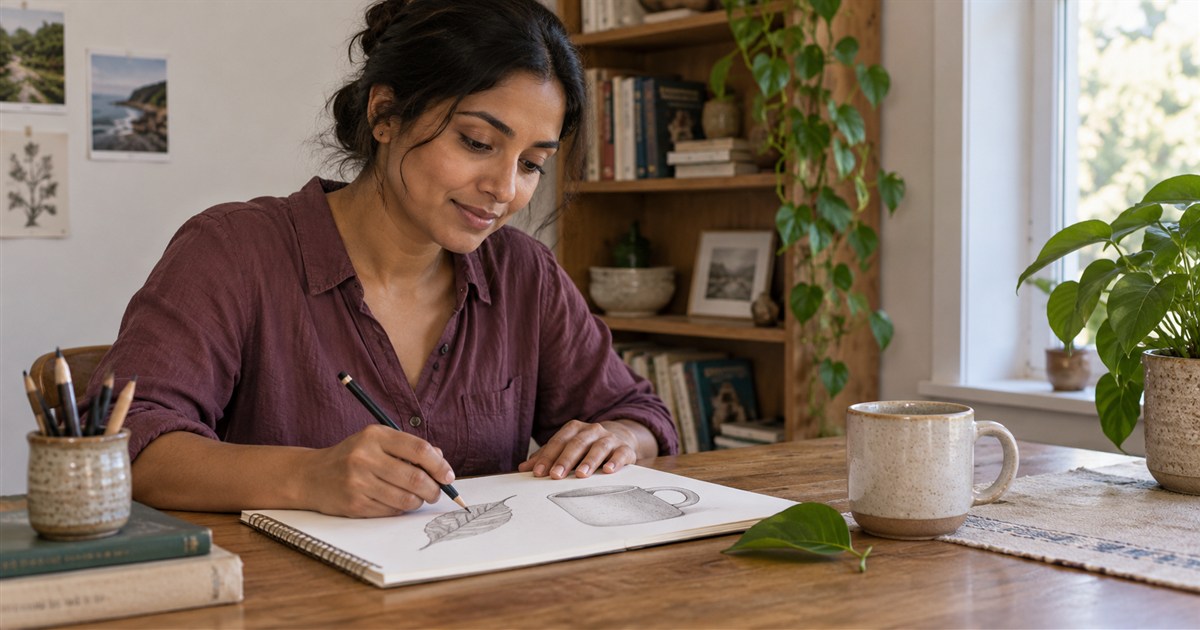
Choose a familiar cup, leaf or book. Write down its colour, shape and visible details. Then look again and notice what you missed. This checks your description against an object in front of you; it does not assess supernatural perception.
2. Sketch without a performance target
Draw a simple object or scene. The purpose is to explore what you notice, not to produce an accurate picture or achieve a particular internal image. You can work with the object visible throughout.
If drawing is not comfortable or accessible, describe it in words instead. There is no required level of vividness.
3. Use a memory game as a memory game
If you enjoy matching-card games, play one normally. Remembering a card you have already seen is not evidence of clairvoyance. Do not change the label of the task because it involves pictures.
Keep the distinction clear between recalling information and claiming information that was never available to you.
4. Make an imaginary scene openly
Invent a setting for a story or a drawing. You might describe a quiet garden, an unusual room or a character’s journey. Label it as imagination rather than a place you have verified spiritually.
You can create the scene with your eyes open using words, sketches or a collage. Do not force an internal picture or keep repeating the activity until it feels like a message.
5. Explore a symbol’s possible meanings
Choose a symbol from a book or deck you already have. List more than one possible interpretation and the context that might change it. “This reminds me of starting again” is a reflection, not a prediction.
Use the divination formats guide to distinguish symbolic tools. You do not need to buy a crystal or another deck for this activity.
6. Record a dream without a future verdict
If you wish, write down a dream after waking. Separate the remembered content from meanings you add later. A dream can become material for art or reflection without proving contact with spirits or a future event.
Do not deprive yourself of sleep or interrupt normal rest to chase experiences. For examining interpretations, see the experience-versus-claim guide.
7. Review the activity rather than your worth
Ask what you enjoyed, what was difficult and whether you want to try it again. You do not have to grade yourself as gifted, blocked or spiritually advanced.
It is acceptable to decide that the activity is not useful. No lack of an image creates a need for paid activation or an explanation about defective energy.
| What you did | What it does not establish |
|---|---|
| Observed an object | Access to hidden information. |
| Recalled a card | Clairvoyance. |
| Created a scene | A verified spiritual location. |
| Interpreted a symbol | A guaranteed outcome. |
No forced physical sign
Do not seek discomfort, pressure in the forehead or unusual sensations as proof of progress. Those experiences should not be given an automatic spiritual diagnosis. Avoid prolonged staring, forced breathing or exercises that become uncomfortable.
The third-eye claims guide separates symbolism from anatomy and assessment. If you prefer an ordinary present-moment pause, see sensory grounding without an energy-cure claim.
Keep curiosity, comfort and the freedom to stop at the centre of the activity.
Frequently asked questions
1. Do these exercises open a third eye?
They are ordinary creative activities, not a method for establishing psychic ability.
2. Is imagining a picture the same as clairvoyance?
No. A picture in imagination does not establish otherwise unavailable knowledge.
3. Must I complete all seven activities?
No. Choose what interests you and leave the rest aside.
4. How can I check an object description?
Compare it with the visible object and note what you missed.
5. Must my drawing be accurate?
No. You can explore observation without a performance target.
6. Can I use words instead of drawing?
Yes. Choose a format that is comfortable and accessible.
7. Does a matching-card game prove clairvoyance?
Remembering cards you have already seen is not evidence of clairvoyance.
8. Must I close my eyes to imagine a scene?
No. You can create through words, sketches or a collage with your eyes open.
9. Is an imagined scene a verified spiritual place?
Label it as imagination rather than treating it as verified.
10. Can a symbol have more than one interpretation?
Yes. Consider alternatives and context instead of a guaranteed outcome.
11. Do I need crystals or a new deck?
No purchase is required for these activities.
12. Does a dream prove spirit contact?
Do not treat remembered content or personal meaning as proof of its source.
13. Should I interrupt sleep to chase a dream?
Do not deprive yourself of normal rest to produce experiences.
14. Does lack of vivid imagery mean I need activation?
No. It does not create a requirement for paid intervention.
15. Is forehead pressure proof of progress?
Do not give discomfort or unusual sensations an automatic spiritual diagnosis.
The author emphasizes the importance of persistent practice in developing clairvoyance. It is reminiscent of techniques used in enhancing cognitive and memory skills, albeit with a metaphysical twist.
The methodologies described for developing clairvoyance are elaborate and require significant dedication. I wonder if there are scientific studies that explore the efficacy of such techniques.
The suggestions presented in the article are quite intriguing. The connection between imagination and clairvoyant abilities is particularly noteworthy. It would be interesting to delve deeper into the neurological underpinnings of these practices.
This article outlines several practical exercises that could potentially enhance mental visualization capabilities. However, the evidence supporting the opening of the third eye remains largely anecdotal.
The instructions for using crystals and maintaining a dream journal are particularly unique. While these may not have mainstream scientific backing, their impact on mental relaxation and focus could be quite beneficial.