


There is no single best job for everyone who identifies as an empath or a sensitive person. Compare the work you would actually do, the setting and the terms—not a stereotype about your personality.
You may enjoy helping people, prefer uninterrupted tasks or need a predictable schedule. Those preferences can point in different directions. Neither emotional sensitivity nor a spiritual identity supplies a professional qualification.
Start with your own examples
Describe two tasks you have enjoyed and two conditions that made work difficult. Be specific: “I like explaining a process one-to-one” says more than “I am good with people.” “Repeated unplanned interruptions disrupt my work” is clearer than “I cannot handle a busy job.”
Keep preferences separate from requirements such as income, travel, caring responsibilities and qualifications. Use the career-comparison guide to connect an interest with actual work options.
Compare seven conditions
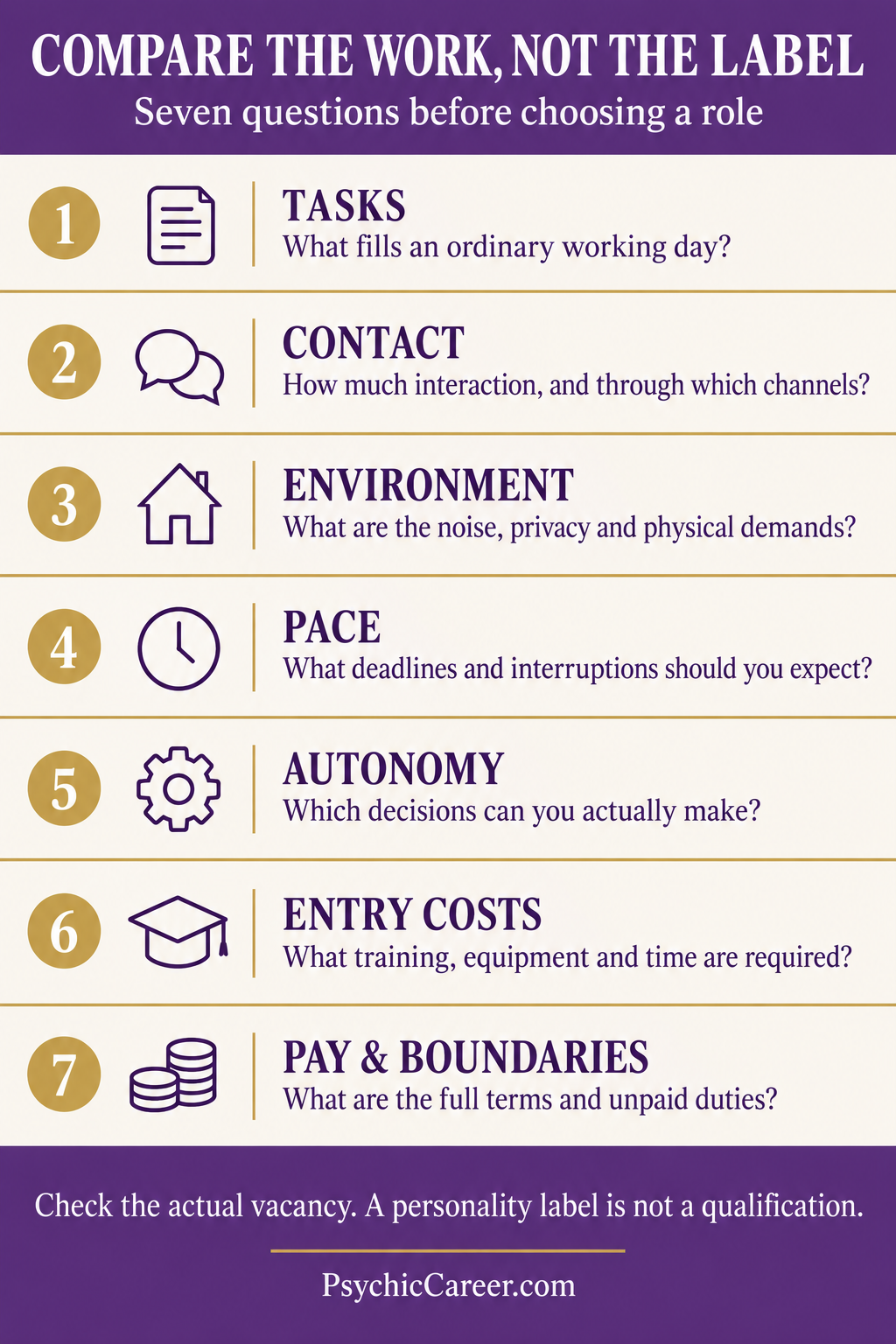
| Condition | What to check |
|---|---|
| Tasks | What will occupy an ordinary working day? |
| Contact | How much interaction, through which channels? |
| Environment | Noise, lighting, privacy and physical demands? |
| Pace | Deadlines, interruptions and peak periods? |
| Autonomy | Which decisions can you actually make? |
| Entry costs | Training, credentials, equipment and time? |
| Pay and boundaries | Full terms, availability and unpaid work? |
O*NET’s work-context information includes contact with others and freedom to make decisions. These occupational descriptions are starting points, not promises about a particular employer or contract. Check the actual vacancy and ask follow-up questions.
Do not idealize a job family
Healthcare, counseling and teaching can involve demanding contact, responsibilities and formal entry requirements. Wanting to help is not enough to practice a regulated profession. Verify the relevant training and licensing requirements for the role and location.
Creative or technical work is not automatically quiet or flexible. It can include clients, deadlines and teamwork. A nonprofit’s mission does not tell you its workload or pay. Look beyond the job title.
Test a shortlist before committing
Choose two or three options. Read current job descriptions and identify what is still unknown. Ask someone in the role about an ordinary day, not just their favorite part.
Where appropriate, try a small sample task or introductory course before making a costly commitment. A sample is information about your experience, not proof that the entire occupation will suit you. Use the shortlist review to compare your findings without inventing a certainty score.
Check self-employment just as carefully
Freelancing or offering readings can let you make some decisions while adding sales, administration, expenses and uncertain demand. Working from home does not remove client contact or guarantee control over every hour.
For a reading practice, define scope and ending times, keep promises within your limits and include unpaid preparation in your plan. Read the practice-planning guide and the working-week planner before relying on a headline session rate.
Choose a next step you can review
Record one option, one missing fact and one manageable next action. You do not need a perfect identity match to investigate a career.
If a job is leaving you exhausted, review workload and practical conditions rather than assuming you lack a spiritual gift. See the work-fatigue review. A decision can remain provisional while you gather better information.
Frequently asked questions
1. Is there one best job for all empaths?
No. Compare your preferences and constraints with the actual role and work setting.
2. Does empath identify a professional qualification?
No. A personal or spiritual identity does not supply required training or licensing.
3. What should I compare first?
Compare everyday tasks, contact, environment, pace, autonomy, entry costs and pay or boundaries.
4. Must a sensitive person avoid people-facing work?
Do not assume so. Consider the type, amount and predictability of interaction you prefer.
5. Does a helping profession necessarily suit me?
No. Check responsibilities, work conditions and formal entry requirements.
6. Is creative work always flexible?
No. It can involve deadlines, clients and fixed working arrangements.
7. Is technical work always quiet?
No. Check the particular setting, teamwork and interruption patterns.
8. Does a nonprofit mission guarantee good work conditions?
No. Review the workload, supervision, pay and practical terms separately.
9. Can O*NET tell me exactly what an employer is like?
No. Occupational descriptions are starting points; confirm conditions for the specific vacancy.
10. How many options should I investigate?
A small shortlist of two or three can make it easier to compare specific information.
11. What should I ask someone in the role?
Ask about an ordinary working day, contact, interruptions, demands and what they wish they had known.
12. Can a sample task prove a career will suit me?
No. It gives limited information that you can compare with the role’s wider demands.
13. Does freelancing remove stress and client contact?
No. It can add administration, selling, expenses and uncertain demand.
14. What should a reading-practice plan include?
Include service limits, availability, preparation, administration, costs and payment terms.
15. What is a useful first action?
Select one option, identify one missing fact and take a manageable step to check it.
The article raises valid points about the challenges that highly sensitive people face in the workplace. Finding the right job can indeed be difficult for those who are easily overwhelmed by stress and sensory input. However, the list of potential careers provided is a helpful starting point for those looking to find a more suitable work environment.
One aspect the article touches on that I find particularly insightful is the idea that highly sensitive people often seek meaningful work. This is a critical factor in job satisfaction for many, regardless of sensitivity. It’s encouraging to see a range of career options that can fulfill this need for meaning and impact.
The article provides a comprehensive overview of the career challenges and opportunities for highly sensitive people. It’s clear that finding the right fit is about more than just avoiding stressful jobs; it’s also about leveraging the unique skills and traits that highly sensitive individuals possess.
It’s important to acknowledge the unique strengths that highly sensitive individuals bring to the table. The careers suggested, such as roles in caregiving and creative fields, align well with these strengths. Highly sensitive people can indeed thrive in positions where their empathy and attention to detail are assets.
The focus on avoiding certain job types, such as sales or high-pressure roles, makes sense for highly sensitive individuals. It’s crucial for sensitive people to be aware of their limits and look for work environments that minimize stress and maximize their natural talents.