

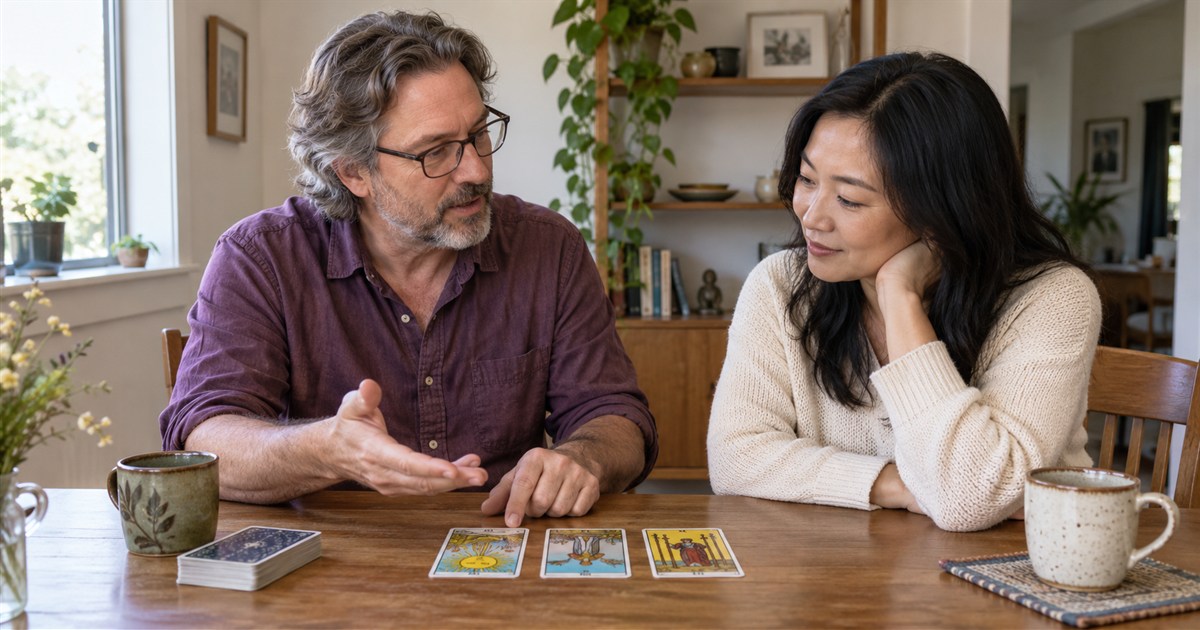
A psychic service may offer tarot interpretation, intuitive impressions, spiritual discussion or claimed mediumship. The word “psychic” does not, by itself, tell you the format, qualifications, limits or accuracy of a particular service.
Start by asking what is actually being offered. You can find a conversation thoughtful or personally meaningful without treating every statement as verified knowledge of your future.
Different services need different questions
| Service description | What to clarify |
|---|---|
| Tarot interpretation | How cards will be used, what topics are included and whether interpretations are presented as reflection or prediction. |
| Intuitive reading | What the reader means by intuition and how uncertainty or disagreement is handled. |
| Mediumship | Whether contact is claimed, what is not guaranteed and how grief-related boundaries are respected. |
| Spiritual coaching | The actual activities, qualifications, scope and distinction from licensed professional care. |
See our guides to psychic, clairvoyant and medium labels and spiritual coaching with clear limits for more detailed comparisons.
Do not mistake an identity checklist for proof
Enjoying solitude, noticing patterns, being creative or taking an interest in dreams does not certify psychic ability. Nor does a person need to adopt that label to be thoughtful, observant or compassionate.
Claims that “everyone is psychic” or that practice guarantees supernatural powers should not be presented as established facts. Belief, popularity and testimonials do not demonstrate how information was obtained. Our ESP overview explains the difference between a label and evidence.
Ask for the terms before paying
- Format: Is the session by phone, chat, email or in person?
- Scope: What questions can be discussed, and what is excluded?
- Cost: What is the full price, including any follow-up?
- Time: What duration or delivery window is agreed?
- Privacy: Who sees your information and what records are kept?
- Control: How can you decline a topic, stop or raise a concern?
Compare the actual offer rather than choosing on a title alone. Use our reader comparison guide if you want a practical shortlist.
Keep consequential decisions grounded
A reading does not replace qualified medical, legal or financial advice. A reader’s impression should not be treated as another person’s consent or as permission to pursue someone who has requested no contact.
Ask for ordinary confirmation of job offers, contracts and health concerns. Do not accept an urgent paid remedy for a threatened curse or a promise that a payment will guarantee a desired outcome.
Review a conversation without overstating it
Afterward, distinguish useful questions or suggestions from specific claims that would need checking. Keep the original wording, include inaccuracies and notice when a statement changed after your feedback. A pleasant conversation and a verified prediction are not the same thing.
You may decline further sessions even if you cannot settle every question about psychic belief. Our reading review checklist and reader ethics guide keep that choice central.
Frequently asked questions
1. Does the word psychic describe one standard service?
No. Ask about the actual format, methods, scope and terms of the particular service.
2. Do all readers use tarot cards?
No. Services may use different approaches. Clarify the approach rather than assuming from the title.
3. Can a reading be meaningful without proving a prediction?
Yes. Personal meaning or a useful suggestion does not independently establish predictive accuracy.
4. Does being creative make someone psychic?
Creativity is not an ability test or proof of extrasensory perception.
5. Is everyone guaranteed psychic powers through practice?
Do not present that guarantee as an established fact. Learning a practice does not by itself verify supernatural ability.
6. Do many believers prove a claim?
Popularity or belief is not independent evidence of how information was obtained.
7. Can a certificate establish accuracy?
A certificate alone does not demonstrate predictive or extrasensory accuracy.
8. What formats should I confirm?
Ask whether the service is delivered by phone, chat, email or in person, and what that format includes.
9. Should I check the full price before paying?
Yes. Confirm currency, duration, included questions and any follow-up or extra charges.
10. What privacy questions matter?
Ask who can see the information, whether the session is recorded and what records or deletion options apply.
11. Can I disagree with a reader?
Yes. A service should allow disagreement and a refusal to discuss a topic.
12. Does a reading replace professional health advice?
No. Seek appropriately qualified care for symptoms, diagnosis and treatment decisions.
13. Can a reader establish someone else’s consent?
No. Consent must come from the person concerned, not from a reader’s impression.
14. How can I review the reading fairly?
Preserve the actual wording and note useful suggestions, inaccuracies, vague statements and claims needing independent checks.
15. Must I continue buying sessions?
No. You can stop or decline more sessions without resolving every question about psychic belief.
I found the discussion on the scientific proof of psychic abilities quite provocative. While the article mentions growing acceptance, it would be beneficial to reference specific studies or scientific evidence to support these claims.
I agree with you, Munchkin. Providing concrete examples or studies would lend more credibility to the assertion that scientific proof is gaining wider acceptance.
The article touches on a significant cultural shift in the acceptance of psychic practices. It would be insightful to examine how this shift has impacted the prevalence of psychic services and their integration into mainstream culture.
The article provides a comprehensive overview of psychic abilities, highlighting both their potential and the necessity for training. It’s interesting to see how the perception of psychic practices has evolved over time.
The traits listed for psychics resonate with qualities typically associated with heightened awareness and mindfulness. It would be interesting to explore how these characteristics manifest in people who do not identify as psychics.
The notion that everyone possesses latent psychic abilities and can develop them through training is intriguing. It parallels the idea that many skills, while requiring some inherent aptitude, can be honed through diligent practice.