

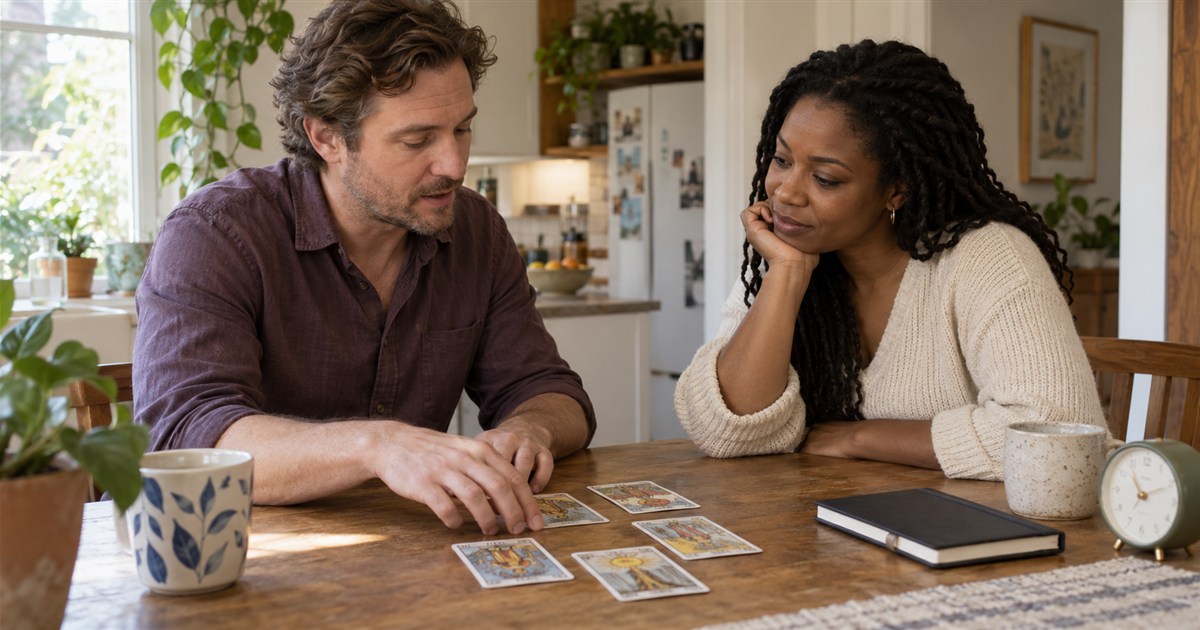
Before trying to develop a reading style, agree what the practice session is for. A willing participant should know that it is practice, what topics are excluded and how to end it without explanation.
Someone being pleased with a session does not establish a supernatural source or future predictive accuracy. You can still review ordinary skills: listening, explaining a format, handling uncertainty and respecting a boundary.
Choose a limited practice task
Use a fictional question or a low-stakes reflection topic chosen by the participant. For example, explore two ways to organize a creative project. Do not ask someone to supply a painful personal story so that you can test yourself.
Cards, imagery or another chosen tool may be part of your format. Explain their role rather than treating the tool as authority over the participant’s choices. Read the guide to reading formats if you are comparing approaches.
Agree these five points before starting
| Point | What to agree |
|---|---|
| Purpose | This is a practice exercise, not a diagnosis or guaranteed forecast. |
| Topic | The participant chooses a suitable topic and may leave questions unanswered. |
| Duration | Set an ending time and do not extend it without fresh agreement. |
| Privacy | Agree whether notes are needed and what happens to them; do not record by default. |
| Stopping | Either person can stop. There is no duty to continue or provide praise. |
During the session: describe, do not impose
Offer an interpretation as something the participant can consider or reject. Avoid claims that you can reveal a third person’s private thoughts, diagnose a condition or determine pregnancy from a card. Those are not appropriate practice targets.
If you get something wrong, accept the correction. Do not reframe disagreement as denial, resistance or proof that your message is especially important. “That does not fit” is useful information, not a failure by the participant.
Keep ordinary information in view. What the participant says, the question they choose and contextual cues can influence your interpretation. A convincing impression is not by itself proof of a paranormal process.
Ask for feedback on the service, not reassurance
- Was the format explained clearly?
- Did you feel free to disagree or stop?
- Was anything confusing or too personal?
- Did I stay within the agreed topic and time?
- What should I change before another practice session?
Do not ask only whether the reading “resonated.” A broad positive answer tells you little about which part was useful. If the person declines feedback, respect that choice.
Review your notes without inventing a score
Record the skill you were practicing and one specific change for next time. Keep corrections and unclear points as well as favorable comments. Do not turn a small informal exercise into an accuracy percentage or a claim that you are certified.
Ask separately before using any feedback publicly. Permission to practice is not permission to publish someone’s story, image or testimonial.
Know when practice is not the right setting
Stop if the conversation becomes distressing, a boundary is crossed or someone needs support beyond your service. You do not need to force images, sensations or a long ritual to prove progress. For a fuller session framework, see reader boundaries and consent.
Before purchasing training, review the course-selection checklist. Before offering a paid service, examine scope, costs and work terms. Practice is preparation for a clearer service—not a promise of acceptance, earnings or psychic accuracy.
Frequently asked questions
1. What should a practice reading test?
Choose an ordinary skill such as explaining the format, listening, handling uncertainty or ending on time. An informal session does not establish supernatural ability.
2. Do I need permission before practicing?
Yes. Explain that it is practice and agree the topic, duration, privacy and stopping process.
3. Can I practice on someone without telling them?
No. Do not turn an ordinary conversation into an undisclosed reading exercise.
4. What topic is suitable?
Use a fictional scenario or a low-stakes reflection topic that the participant freely chooses.
5. Can someone refuse a question?
Yes. Participation does not require sharing private information or answering every question.
6. Do I need cards or another tool?
No particular tool is required. If you use one, explain its role and do not treat it as authority over the participant.
7. Can I predict pregnancy as practice?
Do not use pregnancy or health diagnoses as practice targets. A card interpretation is not a medical assessment.
8. What if my interpretation does not fit?
Accept the correction. Do not label disagreement as resistance or pressure the participant to agree.
9. Does a convincing impression prove psychic ability?
No. Context, information and ordinary cues can shape an interpretation.
10. What feedback is most useful?
Ask about clarity, freedom to disagree, privacy, timing and what should change.
11. Must the participant give feedback?
No. They may decline, and they do not owe you praise or reassurance.
12. Should I record the session?
Do not record by default. Discuss any recording or notes explicitly, including their purpose and what happens to them.
13. Can I publish a practice testimonial?
Ask separately before using feedback publicly. Agreement to practice is not publication permission.
14. Can I calculate an accuracy rate from this?
Do not turn an informal small exercise into a reliable accuracy percentage or certification claim.
15. What should I do when someone becomes uncomfortable?
Stop, respect their boundary and do not force the exercise. Review what needs to change before another session.
I appreciate the focus on finding what works best for each individual. Different methods of meditation and intuitive development can cater to various personal preferences and strengths.
The article effectively underscores the importance of quieting the mind through meditation to enhance intuition. This aligns with many cognitive theories about the benefits of mindfulness practices.
It’s important to highlight that the journey of developing psychic abilities is personal and not a competition. This perspective fosters a more inclusive and supportive environment for learners.
The emphasis on practice and patience is essential for developing any skill, including psychic abilities. The comparisons to learning a new sport or instrument make the process more relatable.
The guided meditation and candle meditation suggestions provide practical steps for beginners. These detailed instructions can help those new to meditation feel less intimidated.